On September 8, US forces put a weapon into the stern of Horizon 1 in international waters 38 nautical miles northeast of Dibba, UAE. The fire spread to the accommodation block, the 16 crew abandoned ship and a bunker barge, the Savona, recovered them, according to maritime security firm Vanguard Tech. CENTCOM listed the ship as one of five Iranian crude oil carriers destroyed that day.
Horizon 1 is not a crude carrier. IMO 9130456 is a 4,686 deadweight ton LPG tanker built in 1996, flagged in Palau and operated by KBT Ship Management in Mumbai, according to Seatrade Maritime and MagicPort. MagicPort's screening reports no sanctions match for Horizon 1. Lloyd's List had nevertheless reported signs of AIS manipulation and suspected Iranian LPG activity involving the vessel in 2024.
That is the pattern across the target set. CENTCOM has hit eight tankers in two rounds since September 5 and describes them as Iran's oil fleet. The records distinguish the state fleet from a wider commercial pool. Three are Iranian-flagged hulls of the National Iranian Tanker Company. Three were named in OFAC's July 30, 2025 action against Mohammad Hossein Shamkhani's shipping network, which Treasury said moves oil for both Iran and Russia, and two of those three had already been listed by London and Brussels under their Russia sanctions regimes. One more was designated by OFAC under another name last November. Horizon 1 is the exception in the screening record, although its trading history had already drawn scrutiny.
The strike list overlaps the sanctions record almost hull for hull. Three targets belonged to a network serving Moscow as well as Tehran. US strikes have now removed vessels from service that European sanctions had restricted for their role in Russia's oil trade.

What Is Visible
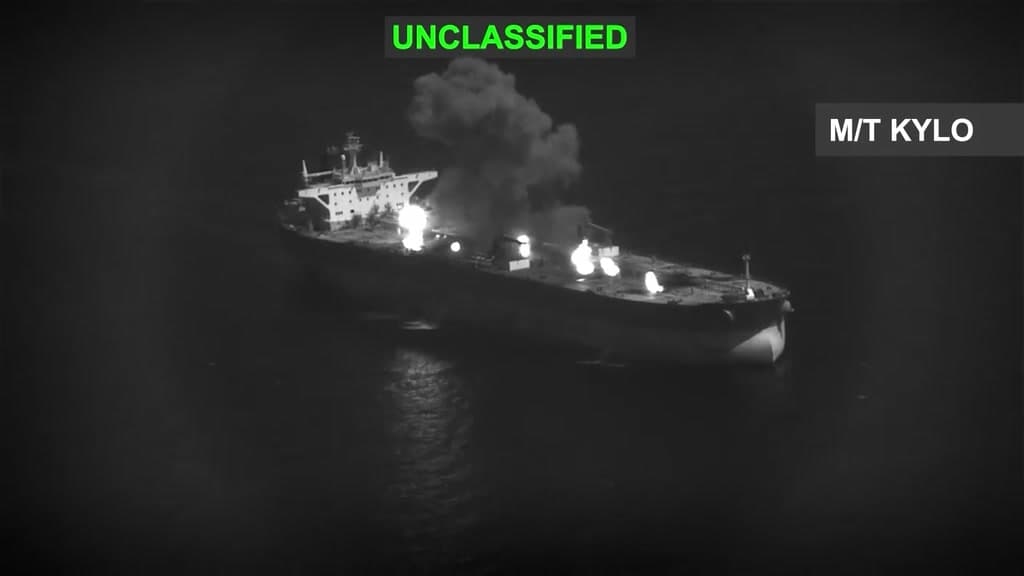
The first round came on September 5, after the IRGC fired ballistic missiles at a US aircraft carrier and a destroyer. CENTCOM said it permanently disabled Downy off Kharg Island and Stark 1 near Jask and completely destroyed Kylo in the Gulf of Oman. Admiral Brad Cooper's statement set the exchange rate: shoot at two of our ships, lose three of yours.
The second round came on September 8 after two more missile launches at a US warship. CENTCOM named Kaviz, Charminar, Horizon 1 and Riesco in the Gulf of Oman and Derya near Kharg, and later published video of Riesco sinking bow first. Secretary of State Marco Rubio told reporters that every time Iran fires at US naval ships it will lose tankers. TankerTrackers.com identified two further NITC hulls, Sinopa and Hawk, struck at anchor off Jask on September 1, which CENTCOM has not confirmed.
The strikes sit inside a blockade CENTCOM resumed on July 14 after a first phase from April 13 to June 18. In its update on September 7, the command said it had redirected 94 commercial ships and disabled three since the resumption. The tanker strikes are the blockade's kinetic tier.
Fleet One: The State Tankers
Downy, IMO 9218480, is a roughly 297,000 deadweight ton very large crude carrier that sailed as Dena before its current name. OFAC lists it as Iranian-flagged and linked to NITC. US forces hit it in the stern at the Kharg anchorage, the loading point for most of Iran's crude exports.
Stark 1, IMO 9171450, has sailed under three earlier names and four flags, per OFAC, which lists it under NITC as well. TankerTrackers reported it had loaded crude at Jask days before the strike. CENTCOM said American forces directed crews to abandon ship before the strikes. Derya, IMO 9569700, is an NITC VLCC that was empty when it was hit at Kharg on September 8, per TankerTrackers.
These three are the state-fleet vessels the conventional read expects. Their Iranian flags and documented NITC links distinguish them from the foreign-flagged ships whose ownership and management have changed across commercial registries.

Fleet Two: The Shamkhani Pool
Kylo, IMO 9189146, was unladen when US aircraft hit it in multiple places on September 5 and it sank in the Gulf of Oman. It had sailed as Memphis and, at the time of the strike, as Noxen. On July 30, 2025 Treasury blocked it as property of Kylo Shipping Inc., one of the Marshall Islands shells it said Shamkhani's network incorporates around each hull. Britain had already listed the same IMO in June 2025 for transporting Russian oil, and the EU Official Journal carries it under the Russia regime for irregular and high-risk shipping practices. Ukrainian military intelligence's war-sanctions database records its port calls at Ust-Luga, Primorsk, Novorossiysk and Gelendzhik alongside Khor Fakkan and Qingdao.
Kaviz, IMO 9282041, is a 115,392 deadweight ton aframax that Treasury blocked in the same July 30, 2025 action under its former name Abhra, as the registered property of Neo Shipping Inc., a Marshall Islands front the release said was incorporated and paid for by a UAE firm in the network. The EU listed the hull in April 2026 and the UK Foreign Office listed it on June 16, 2026, both under Russia sanctions. Equasis carries it as a Comoros false flag with ownership unknown, per Seatrade. Ukrainian intelligence ties it to Fractal Marine DMCC and to dark activity near Ust-Luga.
Charminar, IMO 9318022, a 2006-built product tanker, appears in the same Treasury annex as one of three vessels blocked in the interest of Algae Ship Charter FZCO. The other two are Antares I and Eventin. Eventin is the tanker that lost power and drifted off Rügen in January 2025 with 99,000 tons of Ust-Luga crude aboard, per the Ukrainian database, citing the German response. Charminar's own Baltic history rests on that database alone, so the claim stops there. Its operator's does not.
Treasury's July 2025 release described the network as a fleet of tankers and containerships that changes operators and managers constantly so no hull traces back to the family, moving Iranian and Russian crude mostly to buyers in China. It named Fractal Marine, Progwin Shipping and Crios Shipping among the managers, and said Crios had been exposed in 2024 shipping missile and drone components from Iran to Russia in exchange for Russian petroleum. The same shells and the same aging hulls serve both trades. A vessel's flag does not establish the origin of its cargo.
Britain and the EU imposed port restrictions on Kylo and Kaviz. America put one of them on the bottom of the Gulf of Oman.

Why It Matters Operationally
The European instruments against this pool are port bans and service prohibitions. The UK regulation that lists Kaviz makes it an offence to charter, crew, insure or broker the ship. Kaviz was still afloat when US forces struck it in September. A port prohibition restricts where a ship can trade. Disabling the ship removes its ability to sail.
The potential capacity loss extends to the network serving Moscow. TankerTrackers put the five September 8 hulls at 45 million barrels of Iranian crude and product exported since May 2019. The July 2025 Treasury action identified more than 50 vessels in the Shamkhani fleet, and the three struck this week were drawn from it. A disabled hull cannot return to the Baltic trade until repaired; a sunk vessel must be replaced. These records do not establish whether the network has enough spare tonnage to absorb the losses.
Riesco, IMO 9251822, a 106,500 deadweight ton aframax built in 2003, sank broadcasting a Zimbabwe flag. Zimbabwe has told the IMO it has no ship registry, per Splash247, and Equasis and PurpleTrac carry the ownership as unknown. OFAC had the hull anyway: on November 20, 2025 it added the same IMO to the SDN list as Aquaris, Panama-flagged, linked to Marshall Islands-based Arkadia Maritime Incorporated under the Iran program. CENTCOM's releases describe the ships as a network funding the IRGC and its proxies; they do not cite designations, but seven of the eight carry one.
The sanctions record and the strike record now overlap almost completely. Horizon 1 remains an exception in MagicPort's screening. In 2024, Lloyd's List reported that a manifest placed the vessel at Iraq's Khor al Zubair on September 24, while satellite imagery and AIS analysis cast doubt on that account. The vessel discharged at Mongla in mid-October and subsequently received cargo from Gaz GMS off Chittagong, which the reporting connected to Iranian LPG. That reporting establishes a history of scrutiny; it does not establish what evidence CENTCOM used to select the ship.
The strikes have not exhausted the available fleet. TradeWinds reported that NITC had concentrated nearly two dozen vessels off Sri Lanka. Those ships sit outside the locations of these announced tanker strikes. Their presence shows surviving tonnage, not how much is available for reassignment to other trades.

Conclusion
Rubio's rule is now the operating standard in the Gulf: fire at a US ship and lose tankers. CENTCOM says the tankers fund the IRGC. Treasury placed three of the targets within a shipping network that trades both Iranian and Russian petroleum.
Kaviz and Kylo were listed in London and Brussels under Russia sanctions before US forces struck them in the Gulf of Oman. How much of the network's Russian carrying capacity those losses removed, and whether the network can obtain replacement hulls, is the question the strike videos do not answer.
The appearance of U.S. Department of War (DoW) visual information does not imply or constitute DoW endorsement.
John Hendricks is an OSINT analyst and the founder of Global Recon. Follow on X: @IGRecon