Mocha fell on Thursday, September 10. AP obtained confirmation from National Resistance commander Ahmed Baash and Houthi political official Hazam al-Assad that the Houthis had taken the port city. Tareq Saleh, vice chairman of Yemen’s Presidential Leadership Council, acknowledged casualties over several days of attacks and ordered an alternative command center established in a safe location.
The disruption to shipping predates the offensive by seven weeks. The Houthis declared a naval blockade of Saudi Arabia on July 20. Traffic through Bab al-Mandab fell by about a quarter in the first week of the ban. What the coastal advance could change is where that pressure is applied from and how much of it the Houthis can sustain.
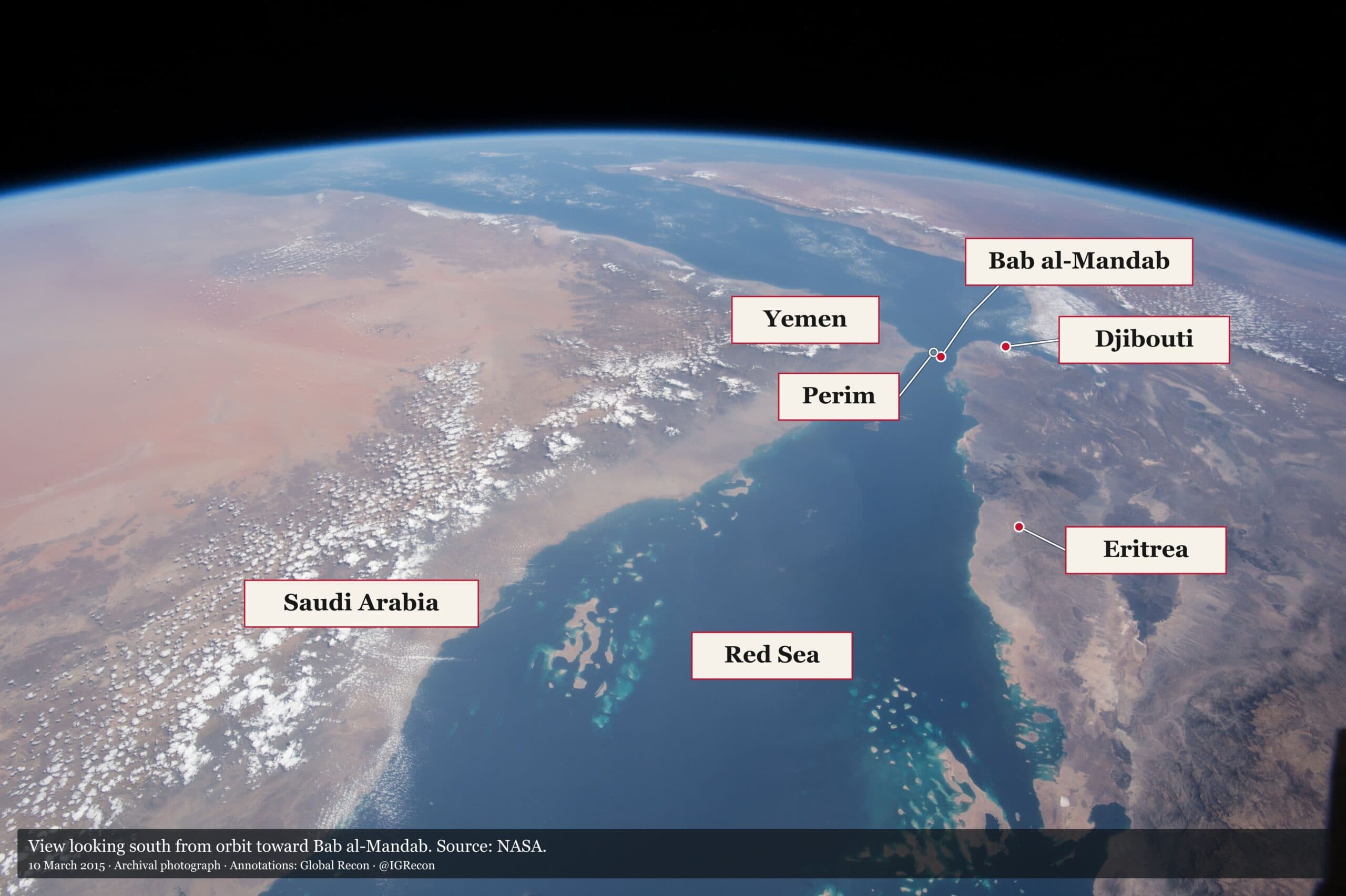
With Hormuz traffic restricted, Yanbu on the Red Sea has become a critical outlet for Saudi crude. The direct route for Asia-bound cargoes from Yanbu runs through the southern exit, where Houthi forces are advancing toward the remaining government positions.
Dhubab district extends to the strait. The town itself lies about 30 kilometers north of Perim Island, with the mainland positions facing the island farther south. France’s hydrographic service places Dhubab and Perim on nearly the same longitude, separated by roughly 17 minutes of latitude. Taking the town would not by itself establish control of the island or the shipping channel.
What the blockade has already done
The baseline is March. Saudi Arabia’s East-West pipeline reached its full capacity of 7 million barrels a day on March 28, while crude exports through Yanbu reached about 5 million barrels a day, according to a person familiar with the matter cited by Bloomberg and reported by Reuters. Yanbu had handled roughly 763,000 barrels a day before the crisis, according to Lloyd’s List Intelligence.
The Houthi ban took effect at noon UTC on July 20. The Humanitarian Operations Coordination Center emailed shipping companies that vessels calling at Saudi ports could be targeted within the movement’s operational reach. Lloyd’s List Intelligence reported that the criteria extended beyond ownership to Saudi cargo and trading connections.
One vessel shows what followed. The very large crude carrier Xin Long Yang, IMO 9761463, managed by Cosco Shipping Energy, departed Yanbu southbound and reversed course while still declaring Qinzhou, China, as its destination. Windward’s tracking documented the reversal. Lloyd’s List subsequently reported that the ship resumed its passage after two U-turns and obtained Houthi clearance, according to sources cited in reporting relayed by PortNews. That report did not reproduce the permit.
Other owners continued sailing. Windward tracked five tankers reversing course on July 20, four carrying Saudi-origin cargo, while three Saudi-linked VLCCs continued crossing or approaching the strait. Three Saudi-flagged VLCCs went dark. The threat produced different routing decisions, including passage by ships with the connections the Houthis said exposed them to attack.
Two days after the ban, the products tanker Encelia, IMO 9240172, was hit approximately 70 nautical miles southwest of Al Shuqaiq. Reuters cited maritime security company Vanguard identifying the vessel and reporting a projectile strike. On August 24, Bahri confirmed that its tanker Amzan was involved in an incident off Yanbu after the Houthis claimed an attack there, according to Lloyd’s List.
The traffic figures show the disruption’s scale. Counting cargo vessels above 10,000 deadweight tonnes, Lloyd’s List Intelligence recorded 269 transits in the week beginning July 20, down 24 percent from 354 the week before. Its September 3 briefing put the weekly average from July 27 through August 23 at 273, about 14 percent below the pre-ban average of 319.
Lloyd’s List Intelligence reported Yanbu exports at 3.8 million barrels a day in late July. That was below the March figure, but the measurements came from different sources and periods. They establish the outlet’s importance without providing a single continuous export series.

How the pressure works now
Two instruments have carried the blockade without requiring the capture of new ground beside the strait.
The first is the ability to attack vessels near the Saudi coast. Encelia was hit off Al Shuqaiq and Amzan off Yanbu, hundreds of kilometers north of Bab al-Mandab. Those incidents exposed ships to danger well before they reached the southern exit.
The second is insurance. Lloyd’s market underwriters began excluding Saudi-linked vessels from war-risk cover on July 24. Windward assessed the exclusion as the primary driver of the sharpest decline in tanker transits. The Joint War Committee also extended its listed risk area roughly 800 kilometers north, bringing calls at Jeddah and Yanbu under additional premiums, according to Lloyd’s List Intelligence.
A ship does not have to be stopped at the strait for its voyage to become commercially unattractive. The prospect of an attack can change an owner’s route before the vessel approaches Yemen.
The coastal offensive could add operating positions to that existing pressure. Its value would depend on what the Houthis could deploy and sustain there. The reporting does not establish a complete picture of their previous surveillance or reach within the narrows.
What the coast could add
Yemeni reporting described the loss of Camp Khalid bin al-Walid and withdrawals from Hays and al-Khawkhah before the fall of Mocha. Al-Masaa Press’s September 9 account placed the camp in the Mokha junction area, approximately 40 kilometers from the port. These are attributed battlefield accounts, not a verified map of every position or road still in use.
Camp Khalid’s importance predates this offensive. When government forces took it in July 2017, military spokesman Abdo Majli told SABA that the camp helped secure Mocha for receiving logistical support and controlled the main road connecting the port with Taiz and Hodeidah. That explains its value as a position. It does not establish what supplies the government had been moving along that road this year.
The same distinction applies at sea. SABA reported on September 9, in a dispatch datelined Mocha, that government naval units engaged Houthi boats and pushed them north toward Hodeidah. The report did not identify where the government boats launched or refueled. It cannot establish what services Mocha’s harbor was providing them.
Dhubab and Perim could offer additional operating positions if taken and held. Perim divides the strait into two channels. Ocean-going traffic uses the wider western channel in both directions, according to the French hydrographic service’s sailing directions. Positions on the island or the facing mainland would bring forces close to the shipping route.
Proximity would matter only if equipment and personnel could be maintained there. Observation posts or boat facilities would require supplies, and their survival under air attack would determine how consistently they could operate.
The Houthis have demonstrated some ability to conduct island assaults. AFP reported, citing one Yemeni military source, that they took Zuqar Island after rocket fire and a boat-borne assault. That account supports a reported amphibious operation. It does not establish sustained control inside the shipping lane.
The August 11 attack on Tihamah shows how broadly the targeting claims can extend. The small cargo ship, listed by LSEG as Egyptian-owned, had departed Mocha before being attacked near Perim, according to Reuters’ reporting citing Ambrey. Ambrey said it was not Saudi-owned or operated.
The Yemeni transport ministry subsequently reported four crew members killed, while coast guard sources said two rescuers also died. The Houthis claimed an attack on an unnamed ship carrying Saudi military equipment, according to Reuters’ updated account. That alleged cargo connection was not independently established. Ownership alone nevertheless offered no reliable boundary to the declared threat.

How the exporters answer
The alternative route runs north through Egypt. Lloyd’s List Intelligence documented VLCCs loading at Yanbu reducing their cargo at departure or partially discharging at Ain Sukhna to meet Suez Canal draft limits. After transiting the canal, vessels moved to Sidi Kerir to top up from the Sumed pipeline before continuing to their destinations.
Lloyd’s List identified DHT Gazelle as one of eight VLCCs that used Suez in the week beginning July 27. The route provides an alternative to the contested southern exit, but an Asia-bound vessel must then sail through the Mediterranean and around Africa.
Windward estimated that full avoidance through the Cape of Good Hope roughly doubles voyage length and adds $2 million to $2.5 million per transit. Actual costs depend on the voyage. The extra sailing also keeps the tanker occupied longer before it can collect another cargo.
The coastal advance could increase the cost of choosing the direct route. Operating positions near the lane would add to the missile threat off Saudi Arabia and the insurance restrictions already affecting voyages. Their capture would not physically obstruct the northern route through Egypt.
Holding those positions presents a separate problem. Houthi-controlled Al-Masirah reported around 40 Saudi-backed airstrikes across four Yemeni provinces on September 10, according to AP. By the evening of September 10, Aden al-Ghad reported airstrikes against Houthi vehicles advancing within Dhubab district. Aden City reported that parts of the district had fallen and clashes were taking place inside Dhubab town, citing unnamed field sources. Complete Houthi control of the town remained unverified. Control of Perim could not be confirmed from the reporting reviewed for this article.
The burden of the beach
The Houthis are spending ground forces to reach a strait they already pressure from a distance. Island positions need regular deliveries of fuel, ammunition and replacement personnel. Sustaining those deliveries under air attack would determine whether the coastal gains become lasting pressure on shipping, while exporters continue adapting their routes.
John Hendricks is an OSINT analyst and the founder of Global Recon. Follow on X: @IGRecon