The Pentagon says no ships have broken through. Lloyd’s List says at least 26 have. Vortexa tracks 34. Pentagon spokesperson Sean Parnell called the Lloyd’s List report “false” on April 21. On April 22, CENTCOM went further, naming specific vessels in media reporting and asserting they had been intercepted, not ferried to market.
Both sides left the reader to trust their analysis. This is a different kind of argument. Everything below can be verified in under ten minutes using public databases. VesselFinder for AIS records. The Treasury Department’s OFAC sanctions search for vessel designations. No paywalls, no subscriptions, no intelligence product. Three vessels are enough to show the pattern. One is now publicly contested between Vortexa and CENTCOM. The other two speak for themselves. The shadow fleet infrastructure behind all of them was built over a decade of sanctions evasion, and nine days of naval pressure have not sealed it.
What the Navy Is Counting
The US blockade of Iranian ports took effect on April 13, 2026 at 10:00 AM ET. CENTCOM reported over 10,000 personnel, more than a dozen warships, and dozens of aircraft enforcing the operation.
The intercept count climbed fast. Six vessels redirected in the first 24 hours. Eight by April 14. Ten by April 15. Thirteen by April 16, when Chairman of the Joint Chiefs General Dan Caine and Secretary of War Pete Hegseth clarified that the blockade applies to Iranian ports and coastline, not the Strait of Hormuz itself. Twenty-three by April 18. Twenty-nine by April 22.
The word CENTCOM uses is “directed.” Most vessels complied with radio warnings. Only two kinetic enforcement actions have occurred in nine days.
On April 19, the destroyer USS Spruance intercepted the Iranian-flagged M/V Touska as it transited the north Arabian Sea at 17 knots toward Bandar Abbas. After six hours of warnings, Spruance fired several rounds from its 5-inch MK 45 gun into the engine room, disabling propulsion. Marines from the 31st Marine Expeditionary Unit rappelled from helicopters and seized the vessel. It was the first time a US Navy ship had struck another vessel with its deck gun in nearly four decades.
On April 21, US forces boarded the sanctioned crude tanker M/T Tifani in the INDOPACOM area of responsibility, between Sri Lanka and Indonesia, more than 2,000 miles from the Persian Gulf.
Two seizures. That is the kinetic footprint of the blockade. Everything else is radio work.

Hero II: The Disputed Case
Open VesselFinder. Type IMO 9362073. The result: HERO2, Crude Oil Tanker, Iran flag, built 2007, 317,355 deadweight tons. A VLCC capable of carrying two million barrels of crude. Above the voyage data, an orange banner reads Sanctions and Bans: US (OFAC). The destination field is blank. The last AIS position was reported 39 days ago.
Now open sanctionssearch.ofac.treas.gov. Type HERO II. The result confirms the vessel is on Treasury’s Specially Designated Nationals list, linked to the National Iranian Tanker Company, designated under executive orders targeting the Iranian petroleum sector.
A 333-meter OFAC-sanctioned Iranian VLCC has not broadcast its position in 39 days. What happened during those 39 days is now the object of an active dispute between Vortexa and US Central Command.
On April 20, Bloomberg reported that Vortexa had captured Hero II and a sister VLCC, Hedy, via satellite imagery passing the US blockade line and moving into the Arabian Sea, fully laden, with combined capacity of roughly four million barrels. The vessels had not broadcast AIS during the transit. Satellite captured what AIS did not.
On April 22, CENTCOM named Hero II and Hedy in a statement pushing back on media reports that commercial ships had evaded the blockade. CENTCOM stated the vessels are anchored at Chabahar after being intercepted by US forces “earlier this week.” The same statement named M/V Dorena as under destroyer escort in the Indian Ocean after a prior attempt to violate the blockade. CENTCOM did not publish the dates of the interceptions, the intercepting platforms, or imagery of the encounters.
Both parties claim satellite access. Both reach opposite conclusions about the same hull. Vortexa has no commercial motive to invent a crossing.
The public record cannot resolve this. AIS is silent. OFAC confirms sanctions status, not vessel location. What a reader can see is the shape of the dispute, not its outcome.

Tifani: The Boarding
Open VesselFinder. Type IMO 9273337. The result: TIFANI, Crude Oil Tanker, built 2003, 299,999 deadweight tons. Flag: Botswana. Orange OFAC sanctions banner. Current position: Indian Ocean, en route to Singapore.
Now OFAC. Type TIFANI. The result: Vessel, IRAN program, designated under Executive Order 13846, linked to ENSA Ship Management Private Limited.
The Botswana flag is the first anomaly. Landlocked countries do not typically operate VLCC-grade crude carriers. Cross-reference other databases and the Tifani is variously listed as flagged by Palau, Cameroon, and Botswana, with three different MMSI numbers. Multiple flag states and multiple transponder IDs on a single hull is not a paperwork error. It is a vessel cycling through identities to avoid tracking.
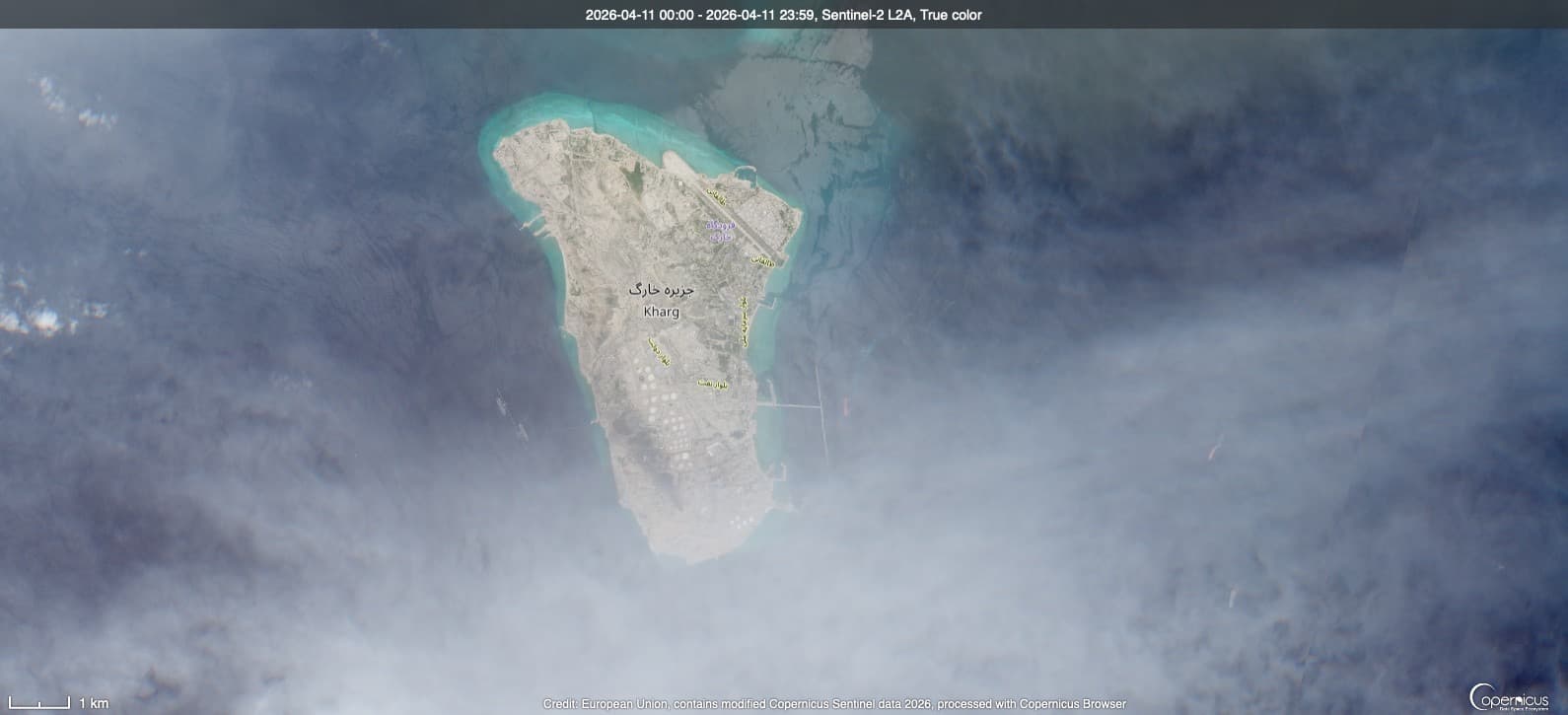
The Tifani is the vessel US forces boarded on April 21. CENTCOM called it a stateless sanctioned tanker. Per Kpler data reported by AFP, the vessel had loaded roughly two million barrels of crude at Kharg Island on April 5, then transited the Strait of Hormuz on April 9, both before the blockade began. By the time Marines from an expeditionary sea base caught up with it sixteen days later, the cargo had already been at sea for more than two weeks.
The boarding shows the blockade can enforce when the vessel is sanctioned, identifiable, and has not cleared the operational area. It also shows the window. The oil was already moving when enforcement started.

Elpis: Dead in the Water
Open VesselFinder. Type IMO 9212400. The result: ELPIS, Chemical/Oil Products Tanker, built 2000, Comoros flag. Orange OFAC sanctions banner. Last reported position: Arabian Sea, eight days ago, speed 0.2 knots. Destination: not available.
A vessel at 0.2 knots is not moving. A vessel that stopped broadcasting eight days ago at 0.2 knots is not just anchored. It is dark.
The Elpis was designated by OFAC in February 2025 under its previous name, Chamtang, for links to Malaysia-based IMS Ltd. Per Kpler data, the vessel departed Bushehr on March 31 loaded with 31,000 tonnes of methanol, transited the Strait of Hormuz after the blockade entered into force, then stopped near Kooh Mobarak on the Iranian coast. VesselFinder records its last port as Bushehr Anchorage, arrival March 26. Kooh Mobarak is an offshore Iranian oil terminal east of the Strait, built to bypass the chokepoint, with surrounding waters used as a ship-to-ship transfer zone.
The last AIS position, near stationary in the Arabian Sea, is consistent with either an STS transfer in progress or a vessel stopped by US forces. After eight days of silence, both scenarios have had ample time to play out.
STS transfers are how the shadow fleet launders cargo. Sanctioned hull pumps to unsanctioned hull, paper trail breaks.
When Elpis stops at 0.2 knots and goes dark for eight days in a known transfer zone, the question is not where it is going. The question is what pulled alongside it while no one was watching.

Beyond the Three
Three vessels are enough to show the pattern. They are not the whole inventory. The maritime intelligence record documents two more methods worth naming.
The first is AIS spoofing. Dark transit hides a vessel. Spoofing disguises it as something else. The tanker Rich Starry, IMO 9773301, was spoofing its AIS between April 3 and April 14, per Lloyd’s List, broadcasting false positions to mask the loading of Iranian cargo. The vessel falsely claims to be flagged by Malawi, a landlocked nation with no legitimate ship registry, which renders it stateless.
The second is identity theft at the vessel level. On April 5, Windward documented a tanker transiting the Strait of Hormuz using the identity of a Japanese-flagged LNG carrier that had been scrapped in 2025. The original vessel’s registry and former management confirmed it no longer exists. Satellite imagery showed the current vessel was not a 290 meter LNG carrier but something in the 245 to 270-meter range, consistent with a different class of ship operating under a stolen identity.
A scrapped vessel does not transit a strait. Something else is wearing its name.
Neither method required military pressure to develop. Both predate the blockade by years. They are now operational against a US Navy carrier strike group because the infrastructure was already in place when April 13 began.
The Definition Problem
Part of the gap between CENTCOM’s numbers and Lloyd’s List’s numbers is definitional. The blockade took effect on April 13. The US did not widen its contraband definition to include Iranian crude and petroleum products until April 16. Lloyd’s List noted that almost half of the 26 vessels it tracked passed the blockade line before the terms widened. Twelve transited after.
The Pentagon may be counting only post-April 16 breaches. Lloyd’s List counts from April 13. Both are measuring from different baselines. Neither framework changes the physical reality: laden tankers are past the blockade line and heading to market. The Tifani boarding settled the ambiguity. US forces interdicted an outbound, sanctioned, laden tanker bound for Singapore, more than 2,000 miles from Iran. The blockade is no longer purely a port-access regime.
What Three Vessels Show
Hero II went dark, and the outcome is now publicly contested. Tifani cycled identities and was caught after the cargo was already on the water. Elpis is sitting at near-zero speed in a known transfer zone. Three vessels, three evasion profiles. One contested by the US government. Two sitting in the public record without dispute.
Extrapolate. Lloyd’s List tracks at least 26 shadow fleet vessels past the blockade line since April 13. Vortexa tracks 34. Windward Maritime AI detected seven VLCCs at Chabahar on April 19 with potential capacity of 14 million barrels, none visible on AIS. United Against Nuclear Iran has logged 47 ghost fleet tankers laden with Iranian oil leaving the Persian Gulf since the start of the conflict.
None of these firms is inventing numbers. The methodology is the same one anyone can run. Check the AIS record. Cross-reference the sanctions database. Correlate against satellite where available. The intelligence firms do it at scale with paid access and SAR imagery. A Global Recon reader can do it one vessel at a time with a browser.
What This Means
The US Navy has directed 29 vessels to turn around since April 13. Two of those have been kinetically enforced. The Touska, seized after six hours of warnings. The Tifani, boarded after loading its cargo before the blockade began.
The blockade can enforce when the vessel is visible, sanctioned, and within a carrier strike group’s operational window. It cannot enforce against vessels that go dark, against identity theft at the vessel level, or against ship-to-ship transfers in a 14 million barrel anchorage east of the strait.
The same infrastructure Iran built to move oil past OFAC sanctions is now moving oil past destroyers. The tools are different. The methods are the same.
The April 21 Pentagon “false” was rhetorical. The April 22 CENTCOM statement was specific. It named hulls, asserted interception, withheld imagery. That is a more credible posture than a blanket denial. It is not sufficient to resolve the public dispute, because Vortexa claims satellite confirmation of the opposite finding and neither side has shown its work.
What the public record does show, outside the Hero II dispute: Rich Starry spoofed its AIS for eleven days. A tanker wearing a scrapped Japanese LNG carrier’s identity transited the Strait on April 5. Tifani loaded its cargo before the blockade began and was boarded sixteen days later. Elpis is sitting at 0.2 knots near an STS zone.
The shadow fleet has been preparing for this for a decade. Nine days of naval pressure was never going to seal an infrastructure built to leak.