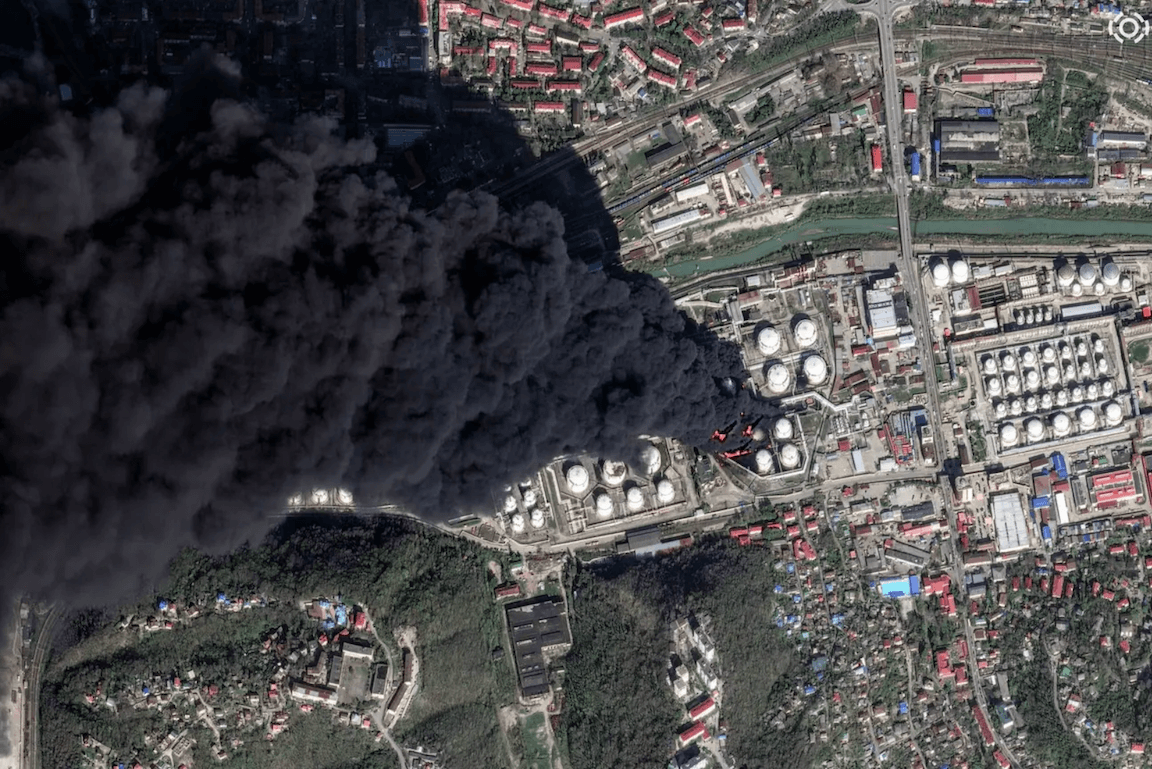
Russia’s Ministry of Defense reported its air defenses destroyed 556 Ukrainian drones overnight on May 16 to 17 across 14 regions. By midday Sunday, the ministry raised the 24-hour figure to more than 1,000 drones shot down or jammed. Moscow Mayor Sergei Sobyanin said Russian defenses intercepted more than 120 drones over Moscow and its environs, with 81 headed toward Moscow itself per TASS. The agency, citing Sobyanin, called it the largest attack on the capital in more than a year.
The Security Service of Ukraine confirmed the strike on the Gazprom Neft Moscow Refinery in Kapotnya, which supplies roughly 40 percent of the capital region’s fuel. Sobyanin reported the refinery’s technology was undamaged. That reassurance is the tell. The mayor of the Russian capital is now publicly defending the integrity of his city’s fuel infrastructure.

The Allocation Problem
The conventional read frames May 17 as retaliation for the Russian strike on Kyiv earlier in the week that killed at least 25 people. That read is incomplete. Retaliation describes the timing. It does not describe the capability that made the timing possible.
Ukraine has shifted from precision embarrassment strikes to industrialized saturation. The mechanism is not destruction. It is allocation. Russia now defends Moscow, refineries, depots, ports, plants, command nodes, naval bases, and occupied infrastructure simultaneously, with a finite interceptor inventory, finite radar cycles, and finite crew rotations. The target list matters less than the math problem it creates for Russian air defense.
Whether the Russian MoD’s 556-overnight and 1,000-per-24-hours figures are accurate or inflated, the implication is the same. Either Russia is committing air defense at that scale, or the Russian state believes it must claim that scale to remain credible. Both readings confirm the same point. Ukrainian production has reached a tempo where Russia is allocating across the entire rear as if it were the front.
The Thirty-Day Refinery Arc
The Moscow Refinery hit on May 17 was the third stop on a thirty-day progression.
Ukrainian drones struck the Tuapse oil refinery on Russia’s Black Sea coast on April 16, 20, and 28, and again on May 1. The dates are confirmed by the Centre for Eastern Studies in Warsaw. The facility is operated by Rosneft and processes about 12 million tonnes of crude oil per year. After the third strike, Krasnodar Krai declared a state of emergency. Russia’s Emergency Situations Ministry claimed on April 29 that the fires had finally been extinguished. The next day, the fourth strike reignited them. Tuapse has been largely offline since mid-April. The blaze produced what local residents called black rain, oil-laced soot deposited across the city.
Ryazan came next. On May 15, Ukrainian drones struck the Ryazan Refinery, also operated by Rosneft. Capacity is 17.1 million tonnes of crude per year, roughly five percent of Russia’s total refining throughput. The plant supplies motor fuels to Moscow and the surrounding region and is a major source of aviation kerosene for the Russian Aerospace Forces. Three people were killed, twelve wounded. Vacuum distillation units burned. A leaked Rosneft engineering report cited by Euromaidan Press conceded that the company’s existing electronic warfare and passive scaffolding defenses cannot stop Ukraine’s long-range drones, leaving facilities like Ryazan exposed to repeated follow-on strikes.
Then Moscow.
Kinetic Sanctions
This is sanctions doctrine carried out by other means. Not financial pressure routed through banks, insurance markets, or export controls. Physical pressure applied to refining capacity, storage, fuel transport, and the air defense capacity required to protect them. Ukrainian drone industry executives, quoted by 19FortyFive in early May, described the Tuapse pattern as a sustained campaign template rather than a series of punitive strikes. The variable being attacked is repair tempo, not raw capacity.
The mechanism is straightforward. Hit a refinery. Wait for the Emergency Situations Ministry to claim the fire is out. Hit it again before repair crews have completed structural work. Capacity does not need to be destroyed. It needs to be denied long enough that the cumulative outage becomes the operating state.
The outcome variable is visible. Reuters, citing Russian industry sources in November 2025, reported that Ukrainian strikes had knocked roughly 20 percent of Russia’s refining capacity offline between August and October. The Moscow Times, citing the quantitative data agency Ciala, put primary refining capacity idle at nearly 38 percent as of late September, with approximately 70 percent of those shutdowns attributable to drone strikes. Domestic fuel shortages have forced Moscow to impose periodic gasoline export bans.
Sanctions through banks ask Russia to choose. Kinetic sanctions remove the choice.
The Production Variable
The May 17 night did not look like a one-off maximum effort. It followed Tuapse, Ryazan, and other deep strikes, and still left Ukraine able to continue the campaign.
That changes the analytical question. For the first three years of the war, the limit on Ukrainian long-range strike was magazine depth. Drones were scarce, targets were prioritized one at a time, and each successful hit was a publicity event as much as an operational one. That period is over. Ukrainian long-range drone production is now sustaining sortie rates that force Russia to commit interceptor inventory, electronic warfare cycles, and air defense crew hours at industrial scale on a recurring basis.
The question is no longer whether Ukraine can hit deep. The question is whether Russia can afford to keep intercepting.

The Hardest Question
Every variable on the Russian side of this exchange is finite, and each is being drawn down faster than it can be replenished. Ukrainian drone production is currently expanding. The constraint is no longer on the firing end of the exchange.
The war’s industrial axis has moved off the front line. It now runs from a network of Ukrainian assembly plants to a network of Russian air defense batteries and refinery repair crews.
The decisive question is no longer whether Ukraine can hit deep inside Russia. It can. The question is whether Russia can defend the rear faster than Ukraine can manufacture the threat.
May 17 did not answer that question. It showed that the question has moved to the center of the war.