Shortly after US and Israeli aircraft began striking Iran on February 28, UAE President Sheikh Mohammed bin Zayed Al Nahyan placed a series of calls to fellow Gulf heads of state. Per Bloomberg reporting citing people familiar with the conversations, MBZ reminded his counterparts that the Gulf Cooperation Council was founded in 1981 in response to the threat posed by Iran’s Islamic Revolution two years earlier. He argued the GCC needed to retaliate as a bloc to deter Tehran. The Saudis, the Qataris, and the Kuwaitis told him in different ways that it was not their war.
That call sequence is the structural fact this article is built around. The Iran war did not produce a unified Gulf response. It exposed a fractured security order in which the UAE moved toward undeclared belligerence, Saudi Arabia paired diplomacy with limited kinetic action, Kuwait became launch geography, and Qatar chose restraint. Iraq absorbed the consequences because the same Iran-aligned formations embedded inside its state were also using Iraqi territory to project force against Gulf capitals.
The UAE struck Iranian territory. Saudi Arabia struck Iranian territory and struck Iran-aligned militia formations inside Iraq, including around the early-April ceasefire window. Kuwaiti soil functioned as a launch site for cross-border strikes into Iraq. Qatar considered kinetic retaliation after Iran hit Ras Laffan and chose not to act.
What is visible
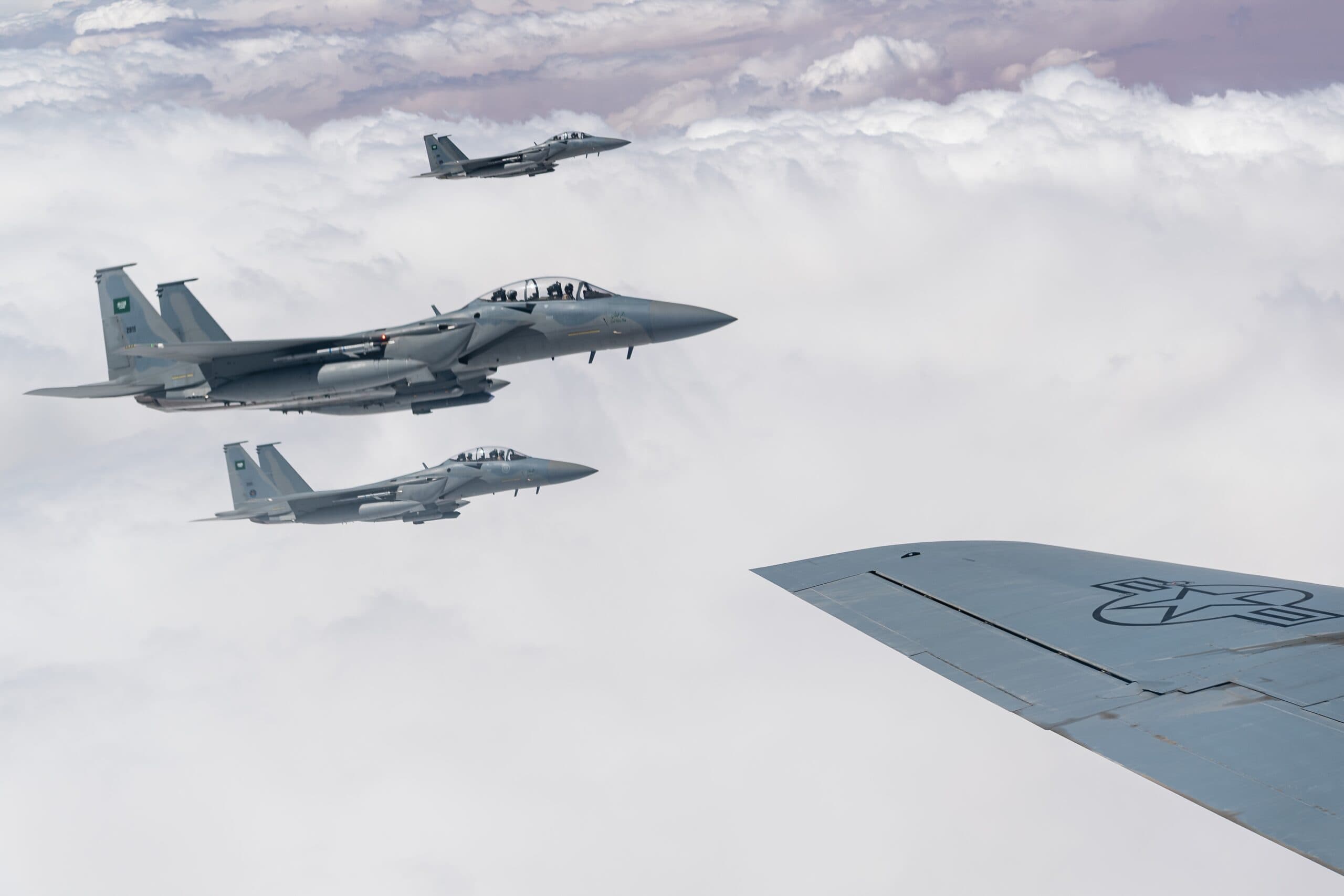
The Wall Street Journal reported on May 11 that UAE aircraft and drones struck Iran’s Lavan Island oil refinery in early April. Reuters reported on May 12 that Saudi Arabia conducted multiple unpublicized strikes directly on Iranian territory in late March, the first known Saudi attack on Iranian soil. A second Reuters piece on May 13 confirmed Saudi F-15s also struck Iran-linked militia targets near the kingdom’s northern border with Iraq, including strikes around the early-April US-Iran ceasefire. Rockets were fired from Kuwaiti territory into Iraq on at least two occasions; one April strike destroyed a Kataib Hezbollah communications and drone facility in southern Iraq. Reuters could not determine whether the rockets were fired by Kuwaiti forces or by the US military, which maintains a large presence in Kuwait.
Netanyahu’s office confirmed on May 13 that the Israeli prime minister had visited the UAE on March 26 and met MBZ in Al Ain. The Wall Street Journal reported Mossad chief David Barnea made at least two wartime visits. Shin Bet chief David Zini visited. Kan reported on May 15 that IDF Chief of Staff Lt. Gen. Eyal Zamir had also flown to Abu Dhabi. US Ambassador to Israel Mike Huckabee confirmed days earlier that Israel had deployed Iron Dome batteries and IDF operators to the UAE during the war.

The Emirati posture: neutral language, belligerent architecture
The UAE is the case the rest of the bloc has to be measured against. It absorbed the heaviest Iranian barrages of any Gulf state. Per UAE Ministry of Defence figures issued by April 9, Emirati air defences had intercepted 537 ballistic missiles, 2,256 drones, and 26 cruise missiles fired from Iran since February 28. It tried to organize a coordinated bloc response and failed. It then went unilateral.
The Wall Street Journal’s reporting on the Lavan Island strike in early April is the documentary anchor, though Reuters carried the WSJ account while noting it could not independently verify. Western-made aircraft and drones penetrated Iranian airspace, hit a major refinery on a strategic island in the Persian Gulf, and knocked most of its capacity out of operation for months. The Wall Street Journal reported that Washington quietly welcomed the action and had wanted broader Gulf participation. The UAE has not publicly acknowledged the strike.
The strike is one element of a wider operational architecture. Israel deployed Iron Dome batteries with Israeli personnel to operate them, the first time Israeli air defense systems have been positioned on Arab soil by invitation. Mossad, Shin Bet, and the IDF Chief of Staff all conducted wartime visits. Netanyahu met MBZ at Al Ain on March 26, the same day the commander of the IRGC Navy was killed. Israeli press reporting indicates joint work on target selection, intelligence sharing, and missile and drone interception.
This is the substance of the relationship the UAE foreign ministry described as conducted within the publicly declared Abraham Accords framework. The ministry’s denial of the Netanyahu visit was not a denial of the underlying cooperation. It was a denial of the secrecy. That is a damage-control posture, not a substantive rejection.
At BRICS in New Delhi on May 14, Iranian Foreign Minister Abbas Araghchi accused the UAE of being an active partner in the aggression. Deputy Foreign Minister Kazem Gharibabadi stated that Tehran had submitted more than 120 diplomatic notes and 500 pages of documentation to the UN Security Council, including specific flight data for warplanes operating from Emirati territory with timestamps and flight paths. The exchange collapsed the joint communiqué. The summit outcome document referenced only differing views among some members.
The institutional residue is visible. The UAE left OPEC and OPEC+ effective May 1, ending six decades of membership and breaking with the Saudi-led production framework. Per Reuters, an Emirati official said Abu Dhabi is reassessing its role across multilateral organizations more broadly, while ruling out further withdrawals at this time. UAE presidential adviser Anwar Gargash told a Dubai conference on April 28 that the GCC’s wartime stance was “the weakest historically.” On May 15, Abu Dhabi Crown Prince Sheikh Khaled bin Mohamed bin Zayed directed ADNOC to fast-track the West-East Pipeline to Fujairah, doubling crude export capacity that bypasses the Strait of Hormuz by 2027. The bloc the UAE has spent four decades inside is the bloc it is now exiting on the energy axis and openly criticizing on the security axis.

The Saudi contradiction
Saudi Arabia is the most analytically interesting actor in the conflict because its posture was not consistent. Riyadh declined the UAE’s bloc-escalation push, pivoted to support Pakistan-led mediation between Washington and Tehran, and per a Gulf official cited by Bloomberg, viewed the Emirati line as escalatory. That is the diplomatic posture.
The kinetic posture is different. Saudi aircraft struck Iranian territory in late March. The Wall Street Journal, citing Saudi intelligence, linked nearly half of the close-to-1,000 drone attacks on Saudi territory to launch points inside Iraq, motivating the F-15 campaign against PMF formations near the Saudi-Iraqi border that continued into the early-April ceasefire window. Riyadh pursued de-escalation and parallel kinetic action at the same time. The diplomatic track lowered the official temperature while the military track imposed costs on the proxy infrastructure. Saudi Arabia summoned the Iraqi ambassador on April 12 to protest cross-border attacks, formalizing the diplomatic posture against the country whose territory it was simultaneously striking.
Kuwaiti launch geography, Qatari restraint
The Kuwaiti case is defined by ambiguity. Reuters could not determine whether the rockets fired from Kuwaiti soil into Iraq were launched by Kuwaiti forces or by the US military, which maintains a large presence at Camp Arifjan and Ali Al Salem Air Base. The ambiguity is itself the participation. Kuwaiti territory functioned as launch geography for cross-border strikes on Iraqi soil, and which uniform pulled the trigger is operationally less important than the fact that Kuwait permitted its territory to be used for that purpose.
The April 7 strike near Basra killed three civilians and damaged a residence. The same day, Iran-aligned protesters stormed the Kuwaiti consulate in Basra. Kuwait summoned the Iraqi representative three times during the war.
Qatar represents the fourth posture. After Iran struck Ras Laffan Industrial City in mid-March, the world’s largest LNG facility, Doha considered a military response and decided against it. The Qatari preference for mediation held. The threshold for kinetic action against Iran existed inside Qatar’s deliberations. It was not crossed. That choice is what makes Qatar legible as a distinct posture rather than a default.

Iraq as the permission structure
This is the analytical core. Iraqi sovereignty was not simply violated during the war. It became the permission structure for everyone else’s violations.
The Popular Mobilization Forces are formally part of the Iraqi state. They draw salaries from the federal budget. They are integrated into the security architecture. The factions most closely tied to Iran’s IRGC, Kataib Hezbollah, Asaib Ahl al-Haq, Harakat al-Nujaba, retain their own command structures, weapons networks, and operational priorities while using Hashd bases and infrastructure. Per Crisis Group, they operate in practice outside the prime minister’s chain of command. The line between state assets and militia operations does not exist as an enforceable boundary.
Caretaker Prime Minister Mohammed Shia al-Sudani authorized Iraq’s security forces, including the PMF, to respond defensively after US strikes on PMF headquarters. The authorization handed Iran-aligned factions a permission framework they could cite as cover for cross-border drone and missile attacks. Saudi Arabia received hundreds of attacks originating from Iraqi territory. Kuwait’s airport, Bahrain’s desalination plant, the UAE’s Fujairah port, all received Iranian fire that in significant part transited or originated from Iraqi soil.
This is why Baghdad cannot protest. Per Moshe Dayan Center analysis of the November 2025 election results, explicitly pro-Iranian militia parties hold 51 seats in the 329-member Council of Representatives, the largest single faction inside the ruling Shia Coordination Framework. Endorsing the Saudi position fractures the governing coalition. Rejecting the Saudi position destroys the bilateral relationship Sudani spent two years rebuilding and risks the Iraq-Saudi pipeline to Yanbu that Baghdad needs as a Hormuz bypass. The Iraqi foreign ministry had not publicly responded to the Saudi strikes as of mid-April. The silence is structurally determined.
Ali al-Zaidi was sworn in as prime minister on May 14, the same day as the BRICS confrontation and one day after Reuters published the Saudi and Kuwait revelations. Zaidi is a businessman with no political background, a consensus pick from the Coordination Framework after Washington vetoed the framework’s first choice, Nouri al-Maliki, with Trump threatening to cut off US support for Iraq if Maliki returned to office. Per The National, US pressure shaped most of the ministerial selections to exclude figures associated with Iran-backed armed factions, though the Iran-aligned Badr Organization secured the water resources portfolio per Al-Monitor. The new government’s first foreign policy test is a disclosure cascade about Gulf Arab strikes on Iraqi soil to which it cannot effectively object.
The structural condition makes Iraq simultaneously the threat and the victim. Iraqi territory is where Iranian proxy attacks on the Gulf originate. Iraqi territory is where Gulf Arab states strike in response. Baghdad cannot enforce sovereignty against the launching network because that network is partly inside the state, and cannot enforce sovereignty against the responding strikes because the launching network is partly inside the state. The PMF is the lock that holds both keys.
What it means operationally
The Arab League framework is now functionally dead as a constraint on intra-Arab kinetic action. Two Gulf Arab states conducted undisclosed kinetic operations against Iran-aligned formations inside a third Arab state, including around the early-April ceasefire window, without UN authorization, without Arab League cover, and without public acknowledgment. Baghdad cannot protest. The threshold for intra-Arab military action has been crossed and the precedent did not produce diplomatic consequences. The next round will assume this template.
The GCC is fragmenting at the institutional level. The UAE’s OPEC exit, its ongoing review of multilateral commitments, Gargash’s public statement that the GCC’s wartime stance was the weakest historically, and the Saudi assessment of the Emirati position as escalatory are not separate stories. They are the same story. The bloc designed in 1981 to coordinate Gulf security cannot coordinate Gulf security. MBZ’s call to MBS was the moment that became operationally visible. Bloomberg’s confirmation that the call happened is the moment it became publicly visible.

Iraq’s regional reintegration project is the structural casualty. The Development Road corridor, the Grand Faw Port, the revived Iraq-Saudi pipeline to Yanbu, all depend on the perception that Iraq is a partner Gulf capitals can build with. The longer Iraqi territory functions as a proxy launchpad, the harder that perception is to recover. The Wall Street Journal reported in late April that Washington had blocked the delivery of nearly $500 million in US banknotes from the Federal Reserve Bank of New York to Iraq, proceeds of Iraqi oil sales, to pressure Baghdad on PMF disarmament. Riyadh’s leverage runs through investment commitments. Both are now conditioned on PMF disarmament Baghdad cannot deliver.
The disclosure pattern is the final question. Six days, six leaks, all running the same direction. The sequencing is hard to dismiss as ordinary leakage. The Wall Street Journal on the Lavan Island strike. Reuters on Saudi direct strikes against Iran and on Saudi and Kuwaiti operations against Iraq. The Netanyahu office on the Al Ain visit, Kan on the Zamir visit, Bloomberg on the failed MBZ-MBS coordination push. Iran already had the flight tracks. The information was not surfacing for Tehran’s benefit. The audience was Arab publics, the Iraqi political class, and the Washington domestic audience that has yet to fully absorb what its allies did during the war.
Whoever is surfacing this is consolidating a new regional posture before it can be denied back into deniability. The question is whether that consolidation is being driven from Washington, from Jerusalem, from the Gulf capitals themselves, or from all three operating in parallel. The Gulf states cooperated to a degree the public record could not have established two weeks ago. The Gulf states could not coordinate that cooperation into a bloc response. Both facts are now in the record. The question of who put them there, and what posture they are meant to lock in, is the one the next phase will answer.