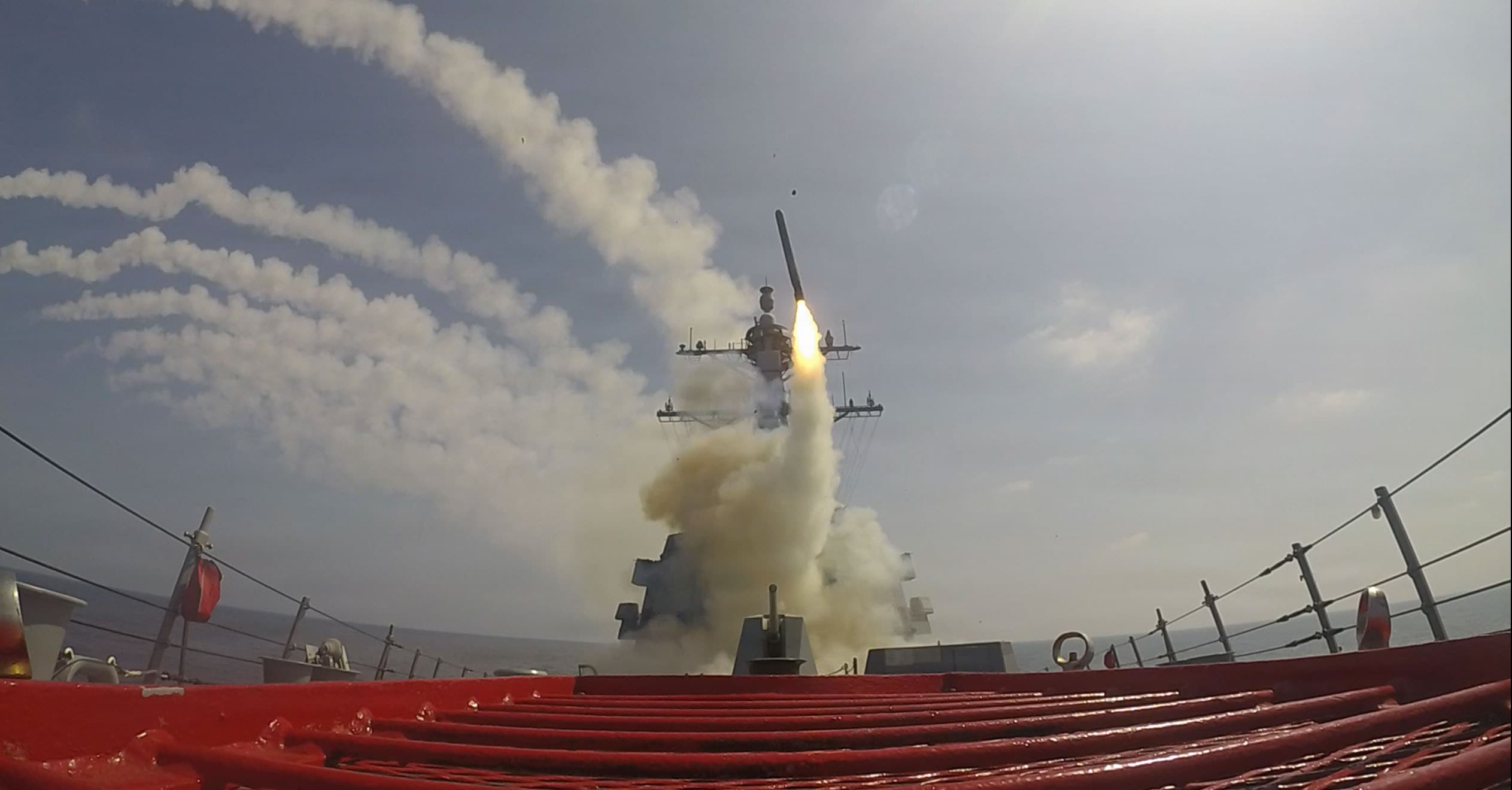
When CSIS published its munitions accounting at the end of May, the line that traveled was the frightening one. The roughly 39-day air and missile campaign against Iran, Operation Epic Fury, had drawn American stockpiles down so far that rebuilding them would take at least three years, opening what the analysts called a “window of vulnerability for a potential Western Pacific conflict.” The framing moved fast because it confirmed a familiar fear, that a war in the Middle East had quietly mortgaged the fight against China.
The number is real. The framing points at the wrong problem.
What the campaign drained was a specific slice of the arsenal, the land-attack strike and ground-based air-defense rounds that take longest to rebuild, on production lines that do not refill until the end of the decade. That much is a counting problem, and counting problems get solved with money, which Congress has already appropriated. The harder problem is the one the headline skips. The Pentagon’s plan to cover a thin magazine is not more missiles. It is mass, thousands of cheap autonomous systems that have not yet shown they can field as mass rather than as inventory, built on a component base China controls at the chokepoints.
The trade is real. It is just not the trade CSIS named. The campaign did not empty the Pacific arsenal. It emptied the shelf slowest to restock, and the plan to refill that shelf from another direction runs through a supply line Beijing can close.
What the numbers show
U.S. Central Command put the campaign at more than 12,000 targets struck. CSIS estimates U.S. forces fired over 1,000 Tomahawks, roughly a third of a prewar inventory near 3,100. Patriot expenditure ran between 1,060 and 1,430 interceptors, close to half the prewar stockpile. THAAD use ran between 190 and 290 interceptors, somewhere between half and, on the higher estimates, four-fifths of available stocks.
The rebuild dates come from the budget books, not from any single guess. Against the FY2027 buy, Tomahawk deliveries do not begin arriving until March 2030. THAAD replacement deliveries start in mid-2029 and finish covering wartime use by the end of that year. Patriot deliveries from the FY2027 order begin in May 2029. Those are the lines that take three years or more. The naval interceptors, the SM-3 and SM-6, return to prewar levels around early 2029 despite light wartime use, held back by long production lead times rather than by any drawdown.
The dates run years out because the lines were sized for a peacetime trickle and are now being asked for a wartime flood. Tomahawk averaged 86 missiles a year over the past decade and still runs under 200, against an expenditure above 1,000; Raytheon’s stated goal of more than 1,000 a year is a capacity it does not yet build. The newest Patriot interceptor is produced at a baseline near 650 a year with half the output going to allies, against a U.S. ten-year procurement average of 225, and the Army has now requested 3,203 in a single budget. THAAD runs at a surge rate around 96 a year while Lockheed plans to quadruple capacity. The lines are not broken. They were built for a drip and are being asked for a deluge, and they compete with orders Washington has also promised abroad, from Ukraine’s Patriots to the 17 other nations that field the interceptor. Reuters reported in May that the United States had already told Switzerland its Patriot deliveries would slip and cost more.

What sits underneath
Read against a Pacific contingency, the depletion is uneven, and the unevenness sits in the rebuild time more than the target set. The three rounds that take three years or more to restore, Tomahawk, Patriot, and THAAD, are the land-attack strike and fixed-site air-defense stack, the munitions that hit fixed targets and protect bases, ports, and capitals. Those are the functions a Pacific war leans on hardest in its opening days, for the defense of Guam, Kadena, and allied airfields and for strike against fixed targets. The naval interceptors that anchor fleet air defense, the SM-6 and SM-3, were used more lightly and return to prewar levels around early 2029, roughly a year sooner. The anti-ship round that would do the ship-killing in the Taiwan Strait, the LRASM, was fired against the IRGC navy in the campaign’s opening hours, but it rides the JASSM line, which CSIS notes is already at surge rate and recovers in months.
So the gap that persists longest is not generalized. It sits in fixed-base air defense and land-attack strike depth, and it sits there because those lines were built smallest. The drawdown did not start with Iran either. The interceptor magazines were already thinned defending Israel in June 2025, which by Breaking Defense’s accounting cost between 30 and 49 percent of THAAD deliveries and a fifth of SM-3 stocks before Epic Fury fired a round.
CSIS says the rest in the lines the headline dropped. The United States has enough munitions for any plausible Iran scenario, and the Pacific concern, by the authors’ own reading, is a timed window rather than an incapacity. The honest claim is not that America cannot fight China. It is that for roughly three years its fixed-base defense and strike depth run thinner than planners want, on the exact lines slowest to refill.
This is where the original accounting stops and the real question begins. CSIS weighed substitution and dismissed it narrowly, noting only that alternative ground-attack munitions are shorter-ranged and expose the launch platform, and that alternative counter-drone systems are expensive. It did not model the substitution the Pentagon is actually betting on. The plan to cover a thin magazine is mass, thousands of cheap attritable autonomous systems meant to absorb the demand that exquisite munitions used to carry.
That program is Replicator, launched in 2023 to field attritable autonomous systems in the thousands inside two years, explicitly to offset Chinese numerical mass. The Defense Department declared the goal met in August 2025. Whether the declaration describes combat power is another matter. The Congressional Research Service noted as recently as January that Congress has never been fully briefed on the program’s specifics, and independent assessments through late 2025 described what was fielded as inventory rather than coherent networked mass, with timelines slipping and program stewardship reshuffled. The airframes exist. The thing that turns airframes into mass, resilient command and control across thousands of platforms in a contested electromagnetic environment, does not yet clearly exist.

SOCOM’s own autonomy push reinforces the gap rather than closing it. The command will retire its crewed surveillance fleet by 2029 and is standing up an Autonomous Warfare Proving Ground at NASA’s Stennis Space Center, with the first industry event scheduled for July. That is real motion. But it is test infrastructure and special-operations ISR, not the strike and area-defense mass a Pacific fight consumes. The autonomy curve is climbing. It is not climbing faster than the missile lines are refilling.
The two timelines are not independent, and the window-of-vulnerability framing misses this entirely. Attritable mass was supposed to take load off the interceptor stack, to serve as the decoys, pickets, and sensors so that scarce Patriots and SM-6s are spent only on the threats that demand them. If the mass does not arrive on schedule, the load does not vanish. It falls back onto the same air-and-missile-defense interceptors the Iran campaign drained. One shortfall deepens the other. The late autonomy program and the slow missile lines are not two risks. They are one risk, compounding.
The supply line underneath the hedge
There is a floor under the autonomy plan, and Beijing poured it. Mass autonomy moves the bottleneck off the missile final-assembly line and onto the parts that fill a cheap drone, the seekers, processors, radio-frequency front ends, magnets, and batteries. That base is Chinese at the chokepoints. CSIS’s own December accounting of the drone supply chain placed semiconductors and sensors among a short list of binding vulnerabilities, and a RUSI study the same season named core electronics, sensors, and motors as the categories where Western producers cannot yet substitute for Chinese supply. China has already shown the lever, restricting drone-component and rare-earth-magnet exports through 2025 and timing the relief to suit itself.
The measure of how far the United States sits from a clean domestic line is the Pentagon’s own Blue List, the roster of drone makers and models certified free of banned Chinese parts. As of its December 2025 launch under the Defense Contract Management Agency, the list held 54 drones cleared for training and 29 cleared for operational deployment, against a commercial drone market China controls by roughly 90 percent. The hedge against a slow missile line runs through a supply line China can close. That is the turn the headline accounting never reaches. The replacement system for the depleted magazine is more exposed to the adversary than the magazine ever was.
Conclusion
Two clocks are running. One is the missile line, refilling the interceptor and strike magazines toward 2029 and 2030. The other is the autonomy curve, which is supposed to cover the interval until the first clock finishes and which has not yet shown it can field mass rather than count units. Neither is moving fast enough to close the hole the other leaves, and the second depends on parts the first does not.
The campaign against Iran did not break American deterrence in the Pacific. It exposed how much of that deterrence now rests on a bet that has not paid out. For the next several years, the line in the Western Pacific holds on something other than full magazines and something short of fielded mass. Nothing in the budget documents or the briefings says plainly what that something is, or who is wagering that Beijing cannot read the same math.