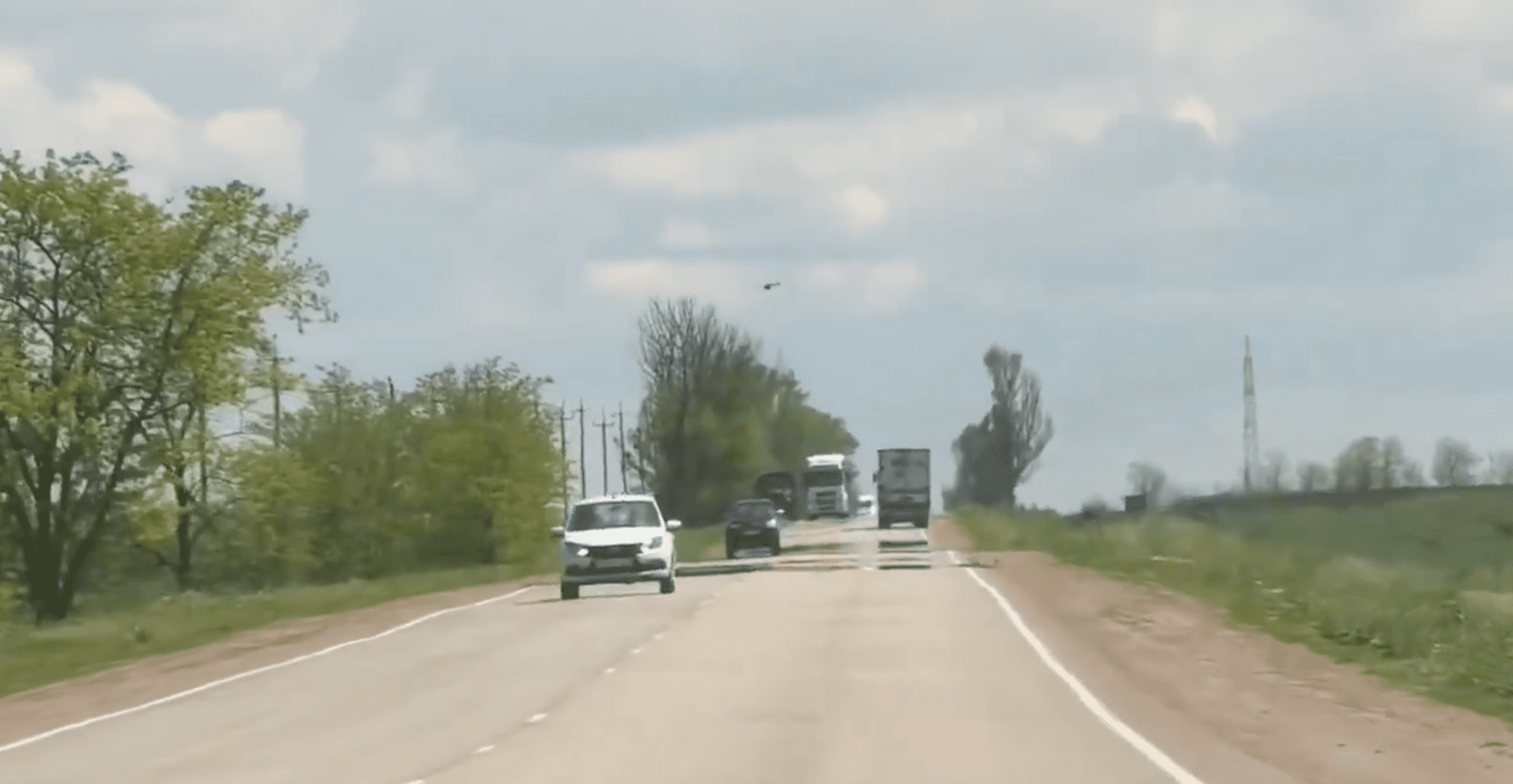
On May 27, Ukraine’s digital minister Mykhailo Fedorov described the campaign against Russian supply lines in the occupied south as a logistics lockdown. The footage behind the claim is hard to argue with. Mapping analysts have logged more than 125 destroyed trucks far behind the front, most of them hit during May, burning along the highways that feed Crimea and the southern front. The wire read writes itself. Crimea is being cut off.
That read is true and shallow. The peninsula is not being severed, and treating the truck count as a countdown to collapse misses what the campaign actually shows. The open-source monitoring group Oko Gora, which has documented more than 60 burned trucks and fuel tankers on two of the main corridors over three weeks, puts the share of military transport it is killing at roughly 5 percent. This is degradation, not strangulation.
The interesting part is not how much traffic is burning. It is which Russian assumption is burning with it.
Moscow spent years building redundant supply lines across occupied southern Ukraine, part of a broader infrastructure push worth close to twelve billion dollars, to reduce its dependence on the Kerch Bridge. Ukraine is now fielding a weapon that does not care which road the traffic takes. The land bridge’s value was that it had no single point of failure. Drone interdiction does not need one.
What is visible
There are two ways into Crimea by land. The Kerch Bridge carries road and rail across the strait from Russia proper. The land bridge runs through occupied southern Ukraine, a coastal arc of highway and rail linking Rostov to the peninsula through Mariupol, Berdyansk, and Melitopol. Russian logistics for the southern front and Crimea are overwhelmingly land-based, and this arc carries the bulk of it.
The arc is now the hunting ground. The coastal highway running from Rostov toward Crimea and the Donetsk-Mariupol road are the two corridors where Ukrainian operators are killing trucks, according to Defense Express, at distances of 50 to 150 kilometers behind the front. A Russian military blogger writing as Rybar described the result from the other side. There is no rear anymore, he wrote, calling travel near the front a lottery.

What sits underneath
The system Ukraine is now pressuring was built on purpose, at scale, to be difficult to sever. After repeated strikes on the Kerch Bridge, Moscow set out to end its dependence on the single crossing. A Reuters investigation published in March, drawn from Russian government budget data, found roughly 11.8 billion dollars allocated to the four occupied regions for 2024 through 2026, nearly three times what some twenty Russian regions received combined. Much of it went to logistics. More than 2,500 kilometers of road and rail have been built or modernized since 2022. The centerpieces are the Novorossiya Highway, the occupied-territory leg of a 1,400-kilometer Azov Ring looping the Sea of Azov, and the Novorossiya Railways, a 525-kilometer line begun in 2023 and routed, in Reuters’ reading of the plans, specifically to bypass the vulnerable Kerch Bridge. Crews have finished most of a 100-kilometer stretch from Taganrog to near Manhush and carved a new bypass around Mariupol. The full ring is meant to close by 2030.
The logic was redundancy. Build enough parallel road and rail that no single strike can sever the connection, and the network becomes secure by having no chokepoint left to hit. Ukrainian military intelligence read the intent correctly. Its deputy chief, Vadym Skibitskyi, called transport infrastructure the single most critical consideration for the Russians. Moscow was hardening against the threat it had already absorbed, a precise strike on a fixed and irreplaceable point.
The threat that arrived attacks the opposite thing. The weapon driving the current campaign is the Hornet, a fixed-wing strike drone built by the US firm Swift Beat, founded by former Google chief executive Eric Schmidt, under a partnership Ukraine announced in July 2025. It reaches 50 to 150 kilometers, loiters up to two hours, and costs somewhere between 5,000 and 12,000 dollars a unit. Ukrainian operators fly it over Starlink terminals and mesh relays to hold the link through Russian jamming. According to Defense Express, it locks onto vehicles in the final seconds of flight, with onboard AI assisting the terminal run. What makes it matter is the combination of cheap range and that terminal lock, not the autonomy itself. Russia has captured and disassembled at least one and designated it Martian-2, which says how badly it wants the capability. The drone has stopped being a single unit’s tool. Its use is spreading across brigades and sectors as production scales, and cheaper first-person-view drones are now reaching past 100 kilometers on their own.
A redundant network is a defense against losing a node. The Hornet does not attack nodes. It attacks links, any truck on any kilometer of any road, and it does so cheaply enough to do it nearly everywhere at once. Adding a parallel highway adds another link to hunt. It does not remove the vulnerability. It multiplies the surface that carries it. Russia bought asphalt to beat a missile and got hunted by drones it cannot count.

Why it matters operationally
George Barros of the Institute for the Study of War calls this a marginal upper hand in drone technology, applied to an old idea. Battlefield air interdiction, the cutting of enemy supply behind the line, used to require strike aircraft and the air superiority to fly them. Ukraine is reproducing the effect with drones that cost less than the cargo in the trucks they destroy. An officer in Ukraine’s 1st Azov Corps drone group put the math plainly. It is better to destroy three trucks delivering ammunition, he said, than the gun firing it.
The exchange rate is the whole argument. Russia cannot air-defend 1,400 kilometers of arterial road at a price that closes against a 10,000-dollar drone. Every kilometer it paved to add redundancy is now a kilometer it has to protect. The investment meant to buy security bought surface area instead.
The limiter is real, and the piece will not pretend otherwise. The 5 percent figure from Oko Gora means the corridors are degraded, not closed. Crimea is still supplied. The edge is temporary by construction. Russia will field counters, and Defense Express notes that Russian industry has already shown a 30-millimeter counter-drone turret. A captured Hornet is also a captured design. The window is the story here, not the verdict.
Conclusion
Two things are true at once. Russia built the most expensive answer it could to the question the last three years posed, how to stop losing the bridge, and against that question the answer is sound. The question changed underneath it. The land bridge is harder to sever than ever and easier to bleed than ever, and Moscow paid close to twelve billion dollars to make the first true without noticing it was making the second true at the same time.
The uncomfortable part is not Russian. Every military that has built supply resilience by adding redundant routes has been hardening against the failure of a node. The weapon that just rewrote that arithmetic is not classified, not scarce, and not Ukrainian alone. The next force to discover that redundancy and resilience stopped being the same thing may not get to discover it in someone else’s war.