In April, Ukrainian military officers stood inside an American air base in Saudi Arabia and taught U.S. airmen how to use their software. The platform, called Sky Map, coordinates drone defense. It was built by Sky Fortress, a company founded in 2022 by Ukrainian engineers who strung more than 10,000 acoustic sensors across their country to hear Russian Shaheds coming. Reuters, citing five people with knowledge of the deployment, reported on April 22 that Sky Map is now operating at Prince Sultan Air Base, roughly 400 miles from Iran.
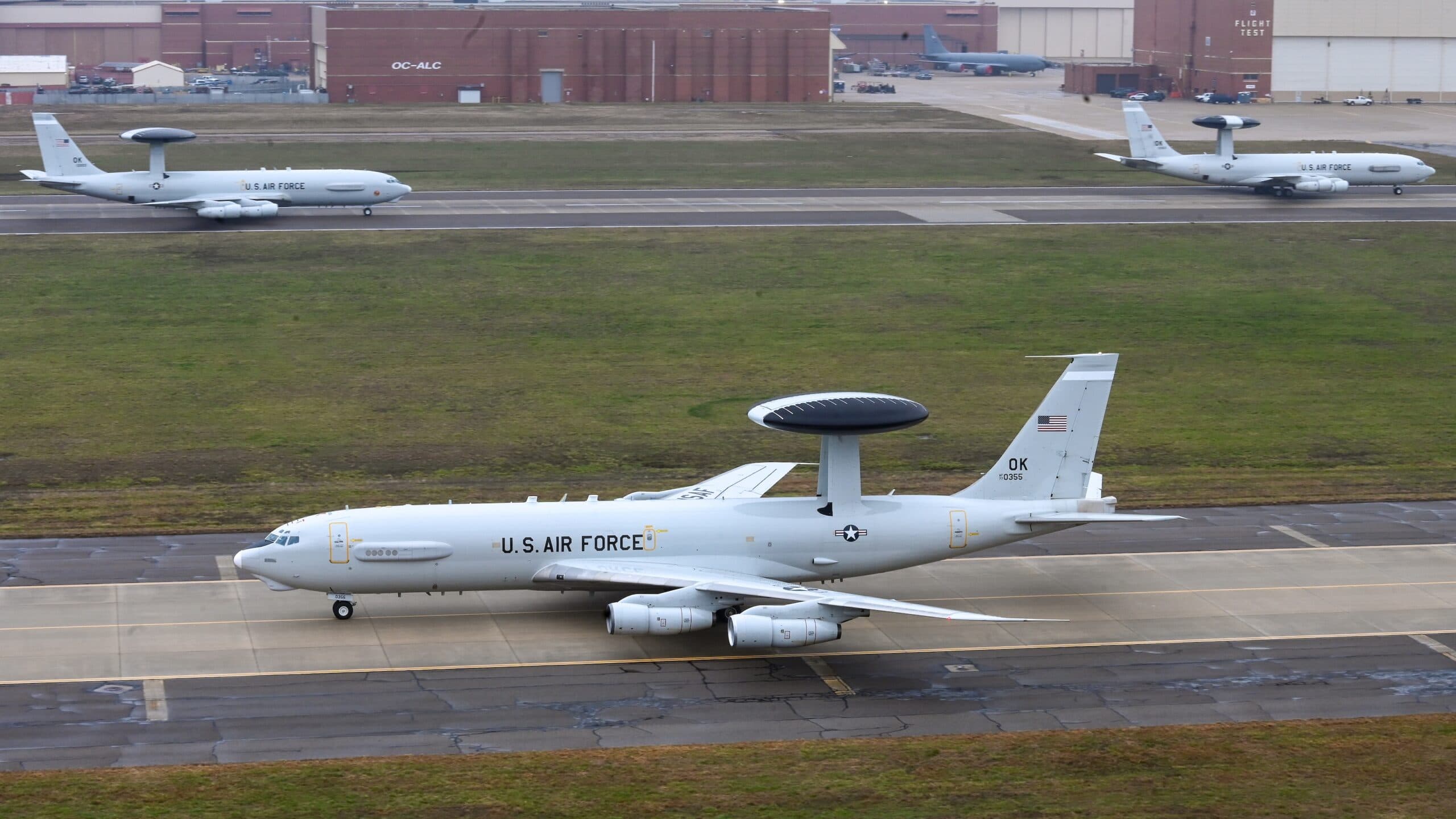
The transfer ran in the wrong direction. The United States operates the most expensive air surveillance architecture ever assembled. In the middle of a war, after Iranian drones and missiles had destroyed aircraft and killed at least one service member at Prince Sultan, it imported a defensive mesh from a country that built it under bombardment. On March 27, an Iranian strike destroyed one of the Air Force’s E-3 Sentry radar aircraft on the ground at the base, per Reuters. KC-135 tankers were damaged in another attack.
The aircraft that defined airborne surveillance for five decades was killed parked. The defense that arrived afterward was Ukrainian.
The conventional read treats the year’s surveillance stories as separate items: a base defense scramble in the Gulf, a vendor milestone in California, a budget fight in Washington. They are one story. Air surveillance is breaking apart into layers, with cheap distributed sensors underneath, unmanned airborne radar in the middle, and satellites above. The Pentagon’s procurement fight is still centered on which exquisite platform replaces another. The layer that proved itself in combat this year emerged outside the acquisition system entirely.
What is visible
On April 22, Reuters reported the Sky Map deployment at Prince Sultan, alongside Merops interceptor drones from Project Eagle, a U.S. firm backed by former Google chief executive Eric Schmidt. The Pentagon’s counter-drone unit, Joint Interagency Task Force 401, had committed $350 million to base defenses under Operation Epic Fury.
On May 19, a General Atomics MQ-9B flew from the company’s Desert Horizon facility in Southern California carrying Saab’s LoyalEye radar pods. Saab and GA-ASI describe it as the first flight of an unmanned airborne early warning system, with a full capability demonstration planned before the end of the year.
And through it all ran the E-7 fight. The Pentagon moved to cancel the Wedgetail in June 2025, citing per-aircraft cost growth from $588 million to $724 million and doubts the plane would survive contested airspace. Defense Secretary Pete Hegseth told lawmakers the mission’s future was in orbit: “We wanted to be able to span the globe.” Congress refused. The FY26 appropriations act ordered development to continue, and in March 2026 the Air Force awarded Boeing two sole-source contract actions to carry the E-7 into engineering and manufacturing development. The same NDAA authorized the full $1.06 billion request for moving target indicator satellites and four more Navy E-2D Hawkeyes to bridge the gap.

What sits underneath
Air surveillance concentrated into a handful of large aircraft because radar economics demanded it. Range requires power, and power requires aperture, generation, and an airframe big enough to carry a crew that can manage the picture. The E-3 flew for five decades because nothing smaller could do its job. Every air force that could not afford one did without.
Concentration is also what made the platforms killable. The countermeasure doctrine built since 1991 targets exactly what makes an exquisite sensor exquisite. Anti-radiation missiles home on emitters. Very long range air-to-air missiles exist to push AWACS orbits back until the radar picture degrades. The Pentagon’s own stated rationale for killing the E-7 was that the aircraft could not survive the environment it was built to watch.
A distributed mesh inverts the targeting math. Sky Fortress sensors cost $400 to $500 each, and Gen. James Hecker, commander of U.S. Air Forces in Europe, has said the entire Ukrainian network costs less than a pair of Patriot missiles. The nodes are passive microphones. There is no emitter to home on, no orbit to push back, and no economical way to attrit a network in which every node costs less than any weapon that can reach it.
The mesh does not do the AWACS job. It cannot track a fighter at 300 miles or manage an air battle. It does one thing: detect low, slow, loud threats flying under radar coverage, and hand a track to a shooter. In February, Ukraine’s commander-in-chief, Gen. Oleksandr Syrskyi, credited interceptor drones with more than 70 percent of Shahed kills over the Kyiv region, roughly 6,300 sorties bringing down more than 1,500 drones in a month. The sensor layer underneath that intercept rate is the one now installed at Prince Sultan. Detecting low and slow threats is the job the E-3 was never doing on the ramp, and the threat class that has hit the base in waves since the war began.
Iran appears to be running the same logic in the other direction. On August 12, The New York Times, citing a single unnamed senior U.S. military official, reported that Iranian drones fed the position, speed, and heading of a U.S. F-15E to commanders before a shoulder-fired missile brought the jet down over southern Iran on April 3. The crew got roughly half a second of warning. Both aviators ejected and were recovered, the weapons systems officer after nearly two days of evasion. The claim remains single-source, and investigators have not established that the drone formations the crew reported seeing were involved in the shootdown. It should be read as conditional. But the architecture it describes needs no breakthrough. Spotting networks are as old as military aviation. Putting them on expendable airframes is assembly, not invention.
The middle layer is where Western industry enters. LoyalEye on the MQ-9B unbundles the radar from the crewed airframe. GA-ASI cites the operational availability of medium-altitude long-endurance drones and the removal of aircrew from the orbit the missiles are aimed at. It is a vendor program, not a fielded capability, and its radar will not match a Wedgetail’s. It does not have to. It has to be cheap enough to buy in numbers and expendable enough to fly where the E-7, by the Pentagon’s own assessment, cannot.


Why it matters operationally
The FY26 fight allocated real money to the two expensive ends of the architecture. Congress forced the E-7 back into development. The NDAA funded $1.06 billion in moving target indicator satellites, a constellation Pentagon officials have said will not deliver the air tracking mission until the early 2030s. Between the airframe Congress saved and the satellites the Pentagon wants sits a decade-wide gap.
The layers filling that gap arrived without a program of record. Sky Map entered U.S. service through Ukrainian trainers on a flight line in Saudi Arabia, six weeks after President Trump told Fox News, “We don’t need their help in drone defense.” JIATF 401’s $350 million moved through emergency channels, not the deliberate budget. The combat-proven layer of the emerging architecture is Ukrainian, exported under fire, and adopted by the United States mid-war because the deliberate system had nothing fielded to offer.
That is the operational fact the E-7 fight obscured. The question facing planners is no longer which large platform wins the air moving target indicator mission. It is whether a surveillance architecture can be stitched together from a congressionally protected radar plane, a middle layer of unmanned radar that exists as a vendor demo, a bottom layer procured from a foreign combatant through task force money, and a satellite constellation that arrives in the 2030s. Each layer answers a different threat. No one owns the seam.
Conclusion
The radar plane is not dying. Congress made sure of that, and nothing in a mesh of microphones or a pod on a Reaper tracks a fighter wing forming up 300 miles out. What broke this year is the assumption that air surveillance is a platform rather than a stack, and that the stack gets built from the top down.
Iran assembled its layer from expendables, if the reporting holds. Ukraine built its layer for less than the cost of two Patriot missiles and is now exporting it to the superpower that spent the spring arguing about a radar plane. The hardest question is not which platform survives. It is why the only layer of the architecture that proved itself in combat this year is the one no acquisition program planned, funded, or owns, and what that says about who builds the next one.