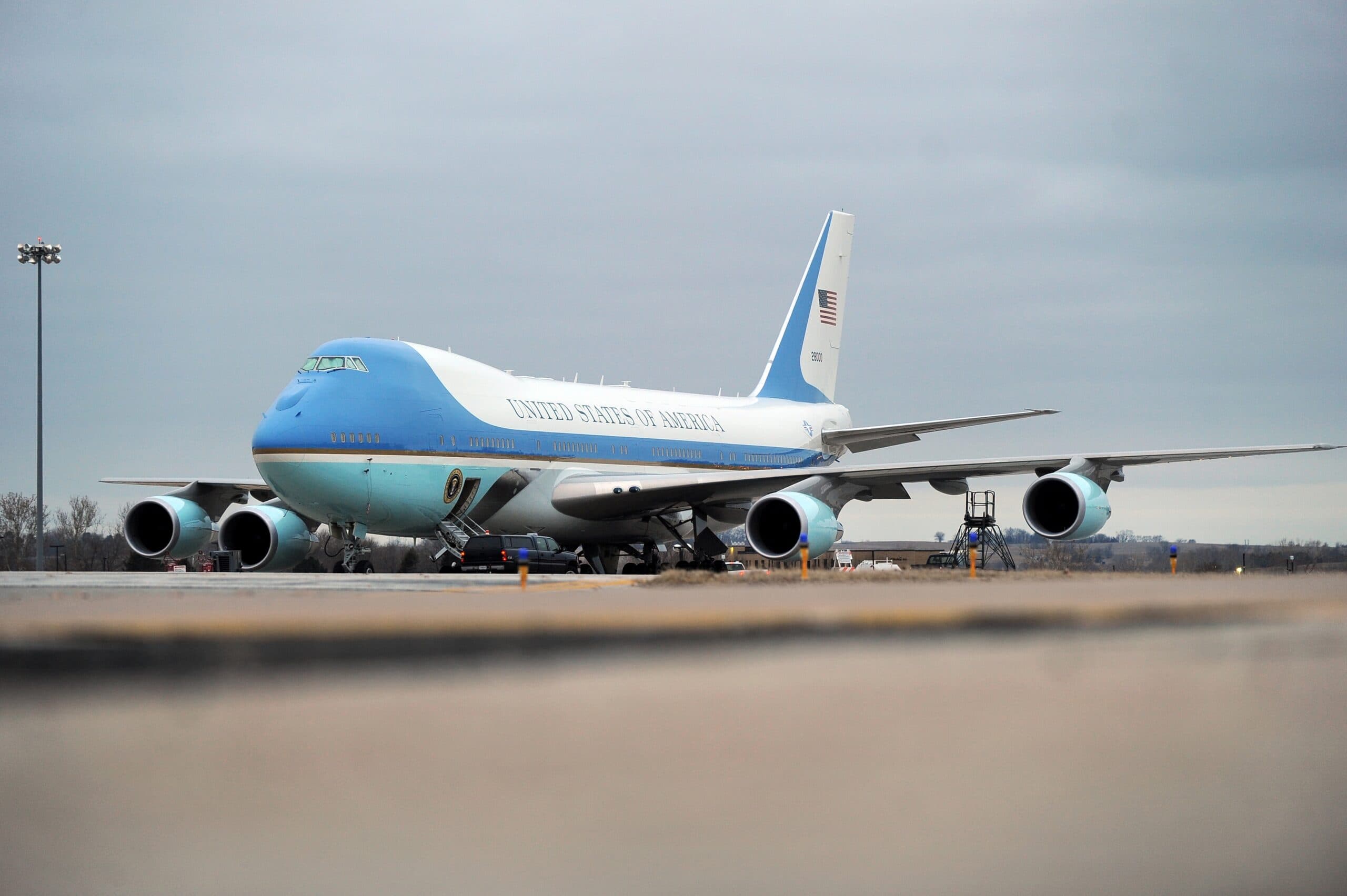
On July 8, President Trump climbed the airstairs of the legacy VC-25A at Ankara Esenboga Airport, waved at the cameras, and stepped inside. He never flew on that aircraft. According to a Washington Post reconstruction published August 10 and confirmed to NBC News by a U.S. official, he was moved off the far side of the jet in a hydraulic catering truck, driven to a C-32A parked nearby, and flown to RAF Mildenhall under the routine military callsign RCH18 with its tracking systems dark. The VC-25A departed as a decoy under the AF1 callsign, carrying the traveling press and members of the cabinet who believed the president was aboard.
The reporting since has fixated on the mechanics. The truck, the 40 seconds it disappeared behind the C-32A’s engines, the window shades the press was told to keep down. Underneath the mechanics sits the operation’s actual content: an intelligence assessment expressed as logistics. Governments do not publish their real estimates of an adversary’s operational reach. They act on them, and occasionally the action becomes visible. In Ankara, the United States behaved as though Iran could build a working kill chain against the president inside the capital of a NATO member, during a NATO summit, within the security perimeter of the Turkish state.
What Is Visible
The essential facts are now multiply confirmed. The Wall Street Journal reported that Israeli intelligence warned U.S. officials of an Iranian plot that included a threat to use shoulder-fired surface-to-air missiles against Air Force One, a warning U.S. Ambassador to Israel Mike Huckabee confirmed came from Israel. The New York Times, citing two U.S. officials, reported that one intelligence stream identified a specific surface-to-air missile threat, that a person was observed near the summit with a shoulder-fired missile, and that Iranian operatives knew where Trump was staying in Ankara down to the floor of the building. No missile was fired. The White House disputed none of the substance, saying only that every tool is used to protect the president.
One caveat belongs in the record. Middle East Eye, citing Turkish officials, reported that Ankara questioned the Israeli intelligence and suspected it may have been shaped to complicate U.S. negotiations with Tehran. The provenance is contested. The American response to it is not.

The Forced Move
The deception was the position the fleet had backed into. Trump flew to Ankara on the VC-25B Bridge aircraft, the converted ex-Qatari 747-8 that entered presidential service on July 1. TWZ has documented that the jet shows none of the visible defensive systems carried by the legacy VC-25A: no AN/AAQ-24 directional infrared countermeasures turrets, no AN/ALQ-204 pulse jammers, no missile launch warning sensors. Trump conceded the gap publicly on July 20, saying the aircraft would be sent off to be “maxed out,” and the White House confirmed a month of upgrades to come.
So on July 8 the airlift picture was this: a new 747 without a proven countermeasures suite, an old 747 with a full suite that the president had publicly announced as his ride home, and a threat report specifying man-portable air defense missiles. A MANPADS warning is not intelligence about intent. It is intelligence about a weapon and a shooter positioned within a few kilometers of a runway. Against that threat, the protected aircraft was compromised the moment it became the advertised target. The deception supplied something its defensive suite could not: uncertainty over which aircraft actually carried the president.
The operation solved the problem by corrupting the targeting picture rather than hardening the target. Three presidential-support airframes at one airport. One advertised departure. One decoy flying the AF1 callsign with authentic passengers behaving authentically. The actual president on a third aircraft under a cargo-run callsign, invisible to public flight tracking. Defense Secretary Pete Hegseth boarded the C-32A in the open, by exterior stairs, per the Post’s reconstruction, dressing the aircraft as an ordinary staff flight. Any observer at Esenboga, on the fence line or inside the terminal, watched exactly what the operation wanted watched.
The cabinet’s ignorance was a component, not a casualty. The Wall Street Journal reported that White House officials, including Secretary of State Marco Rubio, boarded the decoy believing the president was traveling with them as usual. A decoy works only if it behaves like the real flight, and it behaves like the real flight when the people on it believe it is one. Authentic behavior cannot be faked, so nobody whose behavior needed to be authentic was told. One protected output, and everything else at that airport, the cabinet, the press pool, the callsigns, the tracking data, converted into instruments of the concealment. The Secretary of State flew as chaff.
Why Ankara
The threat surfaced in Turkey because Turkey is where the two populations overlap: Iranian operational networks and Western principals. The overlap is documented. In June 2022, Turkey’s National Intelligence Organization detained members of an Iranian-led cell in Istanbul’s Beyoglu district that planned to kidnap and kill Israeli tourists, seizing pistols and silencers from safe houses, after Mossad and MIT jointly rolled up what an Israeli security official described at the time as multiple cells. Months earlier, MIT’s counterintelligence branch had uncovered a nine-person network assembled by Iranian intelligence to assassinate Yair Geller, an Israeli-Turkish businessman in Istanbul, per Turkish reporting on the investigation.
The precedent matters because of what the 2022 cases showed structurally: Iranian services recruiting locally, staging weapons in-country, and surveilling targets for weeks inside Turkish cities. Whether the July network was already in place in Ankara remains unestablished. The record supports something narrower and harder. When U.S. planners received a MANPADS-specific warning in the Turkish capital, the documented history gave them no basis to assume the capability was distant. Washington behaved as if the kill chain could already be local. The 2022 arrests are the reason that assumption was rational.
The Substrate
Underneath the Turkey problem sits four years of indicted evidence that Iran runs lethal targeting against American principals as a standing program. In August 2022, DOJ charged Shahram Poursafi, an IRGC member, with offering $300,000 to individuals in the United States to murder former National Security Advisor John Bolton in Washington or Maryland. In November 2024, DOJ unsealed a complaint against Farhad Shakeri, described as an IRGC asset in Tehran, who told the FBI he was instructed in September 2024 to set aside other work and focus on surveilling and assassinating Trump. When Shakeri said the job would cost a huge amount, the complaint records the IRGC official replying that money was not an issue.
The Shakeri complaint is the clearest public map of the model. A former U.S. prison inmate, deported in 2008, running a network of criminal associates recruited from his prison years to supply the IRGC with surveillance and assassination capacity, including two New York men charged alongside him for tracking an Iranian-American journalist. Target development stays in-house. Execution goes to deniable criminal labor, and for the priority target the payment was uncapped. This is the machine the U.S. government has been describing in charging documents since 2022. The Ankara operation is what it looks like when protective planners take those documents literally.

What It Prices
Read as a price signal, the operation quantifies things officials will not say. It prices the VC-25B’s missing countermeasures as severe enough to build a three-aircraft shell game around, a judgment now visible in the jet’s scheduled upgrade withdrawal. It prices Iranian intelligence penetration of a presidential visit as deep enough that lodging data down to the building floor was assumed compromised. And it prices the Turkish security perimeter as real but insufficient: the U.S. accepted Turkish protection for the airport and treated everything inside it as contested space, running the deception without visible reliance on the host state and, per the Turkish officials’ reaction reported by Middle East Eye, possibly without its knowledge.
The posture has followed the president home. TWZ reported on August 10 that a U.S. Army Avenger short-range air defense system guarded Trump during a golf outing, an air defense footprint around domestic presidential movement that did not exist before the war.

Which leaves the question the operation raises and cannot answer. The deception succeeded, and by succeeding confirmed the capability it was built to evade. If this is what presidential movement requires inside a NATO capital, ringed by allied security, with advance warning and three airframes to shuffle, what does the U.S. assessment of Iranian reach look like in the places that offer none of that?