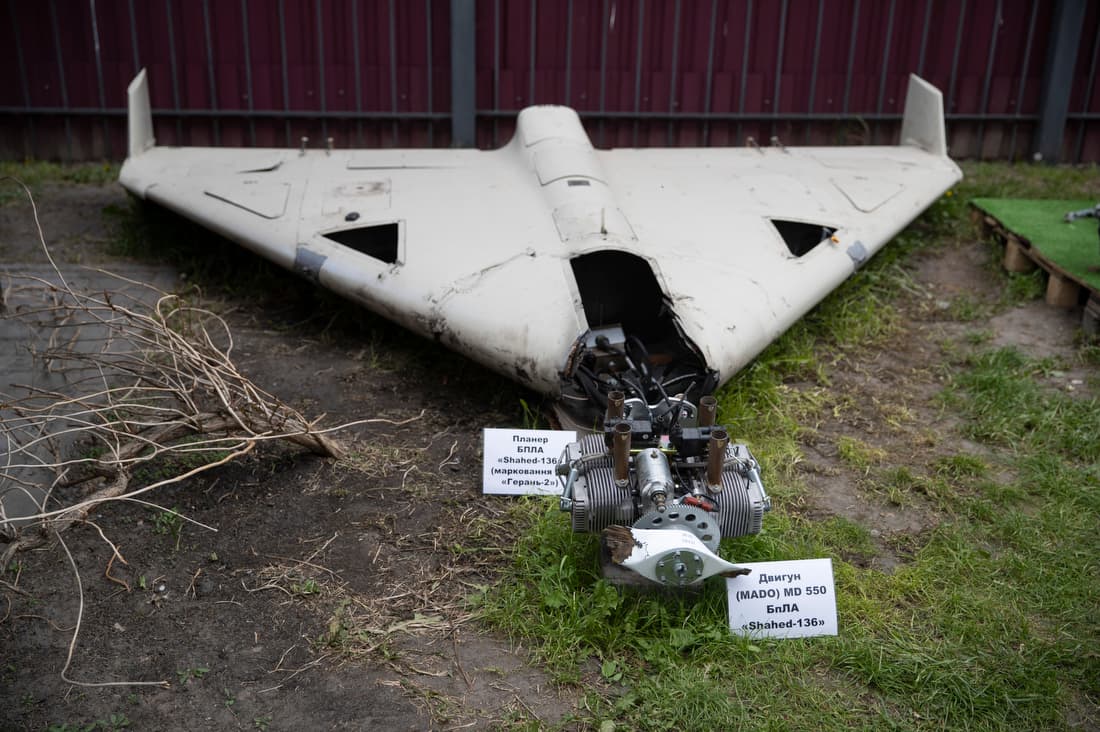
On the night of 13 September, Ukrainian drones reached Nizhnekamsk in Tatarstan, about 1,200 kilometers from the border. The General Staff reported a hit on the Taneco refinery and a storage tank on fire. It was the third strike on Taneco the General Staff has confirmed in five weeks, and the fourth since June.
Alabuga, Russia’s main Shahed factory, sits in the same republic. The last strike there confirmed by the General Staff came on 15 June 2025. The refinery strikes prove Ukraine can reach the region. They do not explain the absence of further confirmed hits on Alabuga.
In May and June 2026, Ukraine struck a different part of the drone supply chain with Flamingo cruise missiles. VNIIR-Progress in Cheboksary makes Kometa anti-jam navigation equipment for Russian drones, missiles and glide bomb kits. By the time the missiles arrived, wreckage reporting had already put Chinese antennas on Alabuga’s assembly line. Ukrainian military intelligence now says antennas of Chinese origin are assembled at Alabuga itself.
Chinese Antennas at Alabuga
Russia builds Shahed-type drones at two sites, and the two sites fit different antennas. In a post from June 2025, the Ukrainian radio specialist Serhii Beskrestnov wrote that the Izhevsk plant installs Russian Kometa antennas with eight or twelve elements. Alabuga, he wrote, had exhausted its stock of four-element Iranian antennas and was installing eight-element units from China. He had reported Chinese antennas in Shahed wreckage as early as the New Year 2025 attack on Kyiv.
Customs records document navigation-equipment procurement at Alabuga. Frontelligence Insight’s investigation, published in August 2025, found that Alabuga Machinery registered imported equipment for producing the Iranian Nasir navigation system in 2024 and 2025. It also found that Morgan, an intermediary registered inside the zone, imported $635,733 in satellite navigation antennas from China. The Insider, working from Russian trade data, put Morgan’s imports of antennas made by the Chinese firm Harxon at more than $1 million in August and September 2024 alone.
The Insider and Nordsint published supplier correspondence on 8 May 2026, three days after the first Flamingo strike on Cheboksary. A Nordsint researcher posing as a Russian military buyer was passed from Harxon’s sales staff to Anthony Zheng of a company called NavX. Zheng issued an invoice for 200 anti-jam antennas. The investigation documents that invoice and stops short of a delivery. “We are working with Alabuga, so we have to make it confidential,” Zheng wrote. Recovered antennas carried Chinese labels describing them as agricultural navigation equipment. After publication, Harxon told its partners that Zheng was not its employee, The Insider reported.
The latest account came from an unnamed military intelligence representative interviewed by Radio Liberty. In the report published on 17 August 2026, he said the first Chinese anti-jam antennas, including sixteen-element designs, arrived as finished imports and are now assembled at the plant in Alabuga and marked ALB. Nordsint had seen the same prefix on recovered antennas and wrote only that it possibly corresponds to the plant.
A Field in October, Halls by September
The factory is also growing and being fortified. Copernicus Sentinel-2 imagery reviewed by Global Recon shows an undisturbed field south of the existing drone halls on 26 October 2025. By 4 May 2026 earthworks cover the site. By 2 September, large roofed buildings stand on both sides of a strip of open ground.

In an analysis published on 27 August 2026, the Institute for Science and International Security identified two rings of lattice towers in Vantor and Airbus imagery. Shorter towers surround the main production halls, and taller ones enclose a wider area. The Institute dated construction to after 18 May, with the inner ring complete by early July, and assessed that the towers could hold a cable mesh against drones or cruise missiles. Their effectiveness has not been demonstrated publicly.
The outer ring takes in Alabuga-Volokno, the Rosatom carbon fiber plant that feeds the drone program. The intelligence account of antenna assembly does not name a building, so it cannot be placed inside either ring.
On 19 September the Ukrainian analyst Dnipro Osint claimed that about 42,000 square meters of underground production space had already been built at the site. His image shows three concrete bays with excavations between them. It carries no acquisition date and no provider credit, and his own label on it reads “future underground workshops.”

Local Assembly, Imported Inputs
Alabuga is taking on more of the work itself while still importing what goes into it. Frontelligence traced roughly 3,000 tonnes of carbon fiber yarn imported by Alabuga-Volokno from China between 2022 and 2025. It named Jilin Tangu Carbon Fiber and Jilin Chemical Fiber Friend Textile as the suppliers. The records do not show how much of that material went into drones.
The same investigation found $972,144 in piston engine components imported from China in 2024 by Drake, an intermediary whose ownership passed to Alabuga Development and Alabuga Machinery. The intelligence representative told Radio Liberty that Russian-made engines have begun appearing in the jet-powered Geran-4, and that about a third of that drone’s components remain Chinese.
An antenna marked ALB can contain Chinese electronics. Bringing assembly on site concentrates another operation at Alabuga while preserving a dependency on Chinese suppliers.
Strikes on One Supplier
Documented strikes on VNIIR-Progress include hits the General Staff confirmed on 9 June 2025, 26 November 2025, 5 May 2026 and 10 June 2026. The June 2026 statement named the FP-5 Flamingo and credited the Ground Forces’ missile and artillery troops.
The plant had tried to protect itself. After the 5 May strike, the OSINT project CyberBoroshno analyzed satellite imagery and found the missile had hit the front of the main building, which was already under anti-drone netting. ASTRA identified metal towers and protective mesh in footage from the 10 June attack. Radio Liberty assessed from satellite imagery that the main building was almost completely destroyed.
In a response to Forbes Ukraine, military intelligence put Russian Geran-2 production at about 2,700 a month at the end of May 2025. On 12 August 2026, Militarnyi reported an intelligence estimate of about 2,800 a month, identifying Alabuga as the main production site. The August 2026 estimate was slightly higher than the estimate published before the June 2025 strike.
Two national totals cannot show what the strikes did. Neither figure is broken down by factory. A temporary interruption, stockpiled antennas, substitution or expansion elsewhere would all disappear inside them. Cheboksary also serves customers beyond the drone program. The General Staff lists Kometa equipment in Shahed-type drones, Kalibr and Iskander-M missiles, and guidance kits for aerial bombs. Disruption to missile or glide bomb production would not appear in a Geran-2 count.
The factory split gives a concrete reason why the strikes could affect the two production sites differently. Izhevsk was reported to fit Kometa antennas. Alabuga, the larger site, was reported to fit Chinese ones.
The Constraint Has to Reach the Customer
Alabuga had a Chinese antenna source before the Flamingo strikes. Cheboksary’s remaining customers determine how far the damage travels: a missed Kometa delivery matters where another module cannot arrive in time.
John Hendricks is an OSINT analyst and the founder of Global Recon. Follow on X: @IGRecon