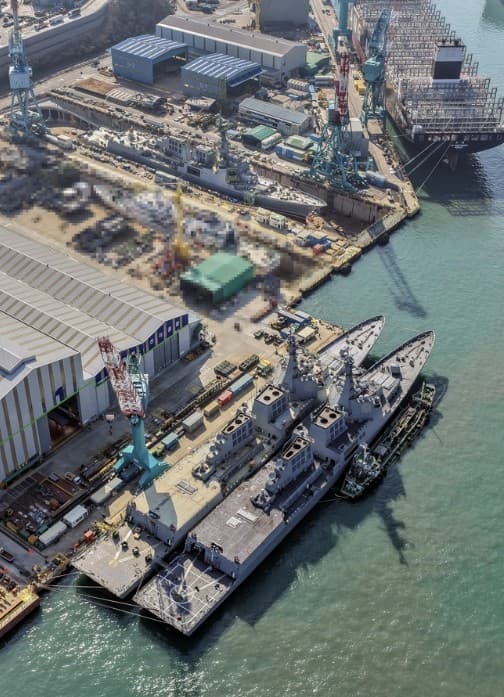
DATELINE: WASHINGTON — APRIL 27, 2026 Within seventy-two hours last week, the Pentagon disclosed three procurement decisions that share the same industrial base. Space Systems Command announced 20 Other Transaction Authority awards worth up to $3.2 billion to 12 companies for Golden Dome boost-phase interceptor prototypes, with an initial capability demonstration targeted for 2028. Space Systems Command also posted a sources-sought notice for up to 25 additional high-energy NSSL Phase 3 Lane 2 missions across fiscal 2027 to 2029. The fiscal 2027 budget submission included $1.85 billion in research funding to study foreign designs and allied-yard construction options for future U.S. frigates and destroyers. This is not three procurement stories. It is one industrial-base story. Washington is funding an orbital missile-defense layer, conceding it lacks the launch capacity to lift it, and pricing the option of building U.S. frigates and destroyers in Korean and Japanese yards because domestic yards are closed out. Each leg traces to a public document.
The interceptor awards, structured under OTA to fund competing prototypes rather than an immediate down-select, run alongside a $17.5 billion FY2027 Golden Dome request, of which only $398 million sits in the base budget. The 25 additional high-energy launch missions were described as emergent requirements not anticipated when Lane 2 contracts were awarded last April, and they would land on Vulcan and Falcon Heavy at the same moment Vulcan remains constrained by a solid-rocket-booster anomaly investigation. The shipyard study, included in the FY2027 budget at OMB direction after the Constellation-class cancellation, would require a presidential national-security waiver under 10 U.S.C. 8679 before major hull components could be built in foreign yards. Throughput is the binding constraint. Watch where the FY2027 reconciliation language lands on workforce and supplier funding, which of the 12 SBI vendors actually book launches against an already saturated NSSL manifest, and whether the foreign-yard waiver moves to the President’s desk. The architecture is funded. The yards are not.