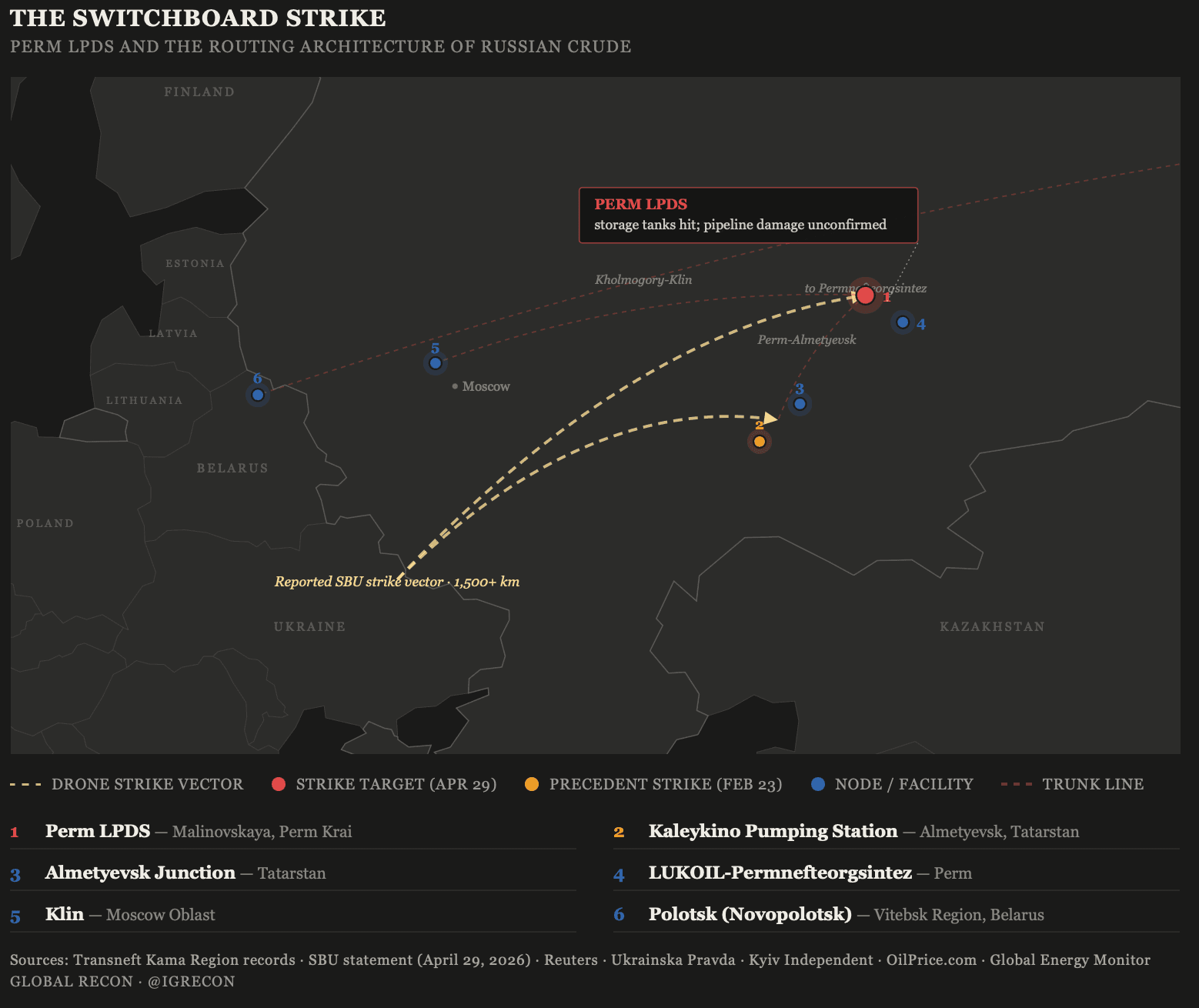
Ukraine’s Security Service struck the Perm linear production and dispatch station overnight on April 29, setting nearly all storage tanks at the facility ablaze, the SBU said. The operation, led by the agency’s Alpha special operations center, flew more than 1,500 kilometers from Ukrainian territory. Perm Krai Governor Dmitry Makhonin confirmed the strike on Telegram, citing a fire at an industrial site and the evacuation of workers. The facility belongs to Transneft, which moves more than 80 percent of Russia’s crude.
This is the second routing-node strike in two months. The first hit Kaleykino in Tatarstan on February 23, a blending and dispatch hub that feeds roughly one million barrels per day into the Druzhba network and the Primorsk and Novorossiysk export corridors. Transneft cut crude intake by 250,000 barrels per day after that strike, per Reuters sources. Perm performs the same function for Western Siberian crude. Oil dispatches in four directions across the Surgut-Polotsk, Kholmogory-Klin, and Perm-Almetyevsk trunk lines, plus the feed to LUKOIL-Permnefteorgsintez.
The pattern is now visible: endpoints first, then switchboards.
The distinction matters at the network level. Endpoint strikes on refineries and export terminals reduce throughput at a single asset. A strike on a routing node forces Transneft to reallocate flow across pipelines engineered around fixed dispatch logic. Recalibrating allocation across four intersecting trunk lines is measured in days or weeks, not hours. Whether the dispatch infrastructure or trunk valving at Perm was damaged has not been confirmed by Transneft or downstream refinery operators. The SBU statement reports nearly all storage tanks burning, which speaks to tank farm damage but not yet to the pipes themselves.
The benchmark is Kaleykino. That strike forced a publicly reported 250,000-barrel-per-day intake cut. The next signals on Perm are throughput disclosures at the Permnefteorgsintez refinery, force majeure notices on Druzhba deliveries via the Almetyevsk junction, and any Transneft instruction to Western Siberian producers to slow output. Two switchboard strikes, two months apart. If the third lands before summer, the campaign’s logic is settled.