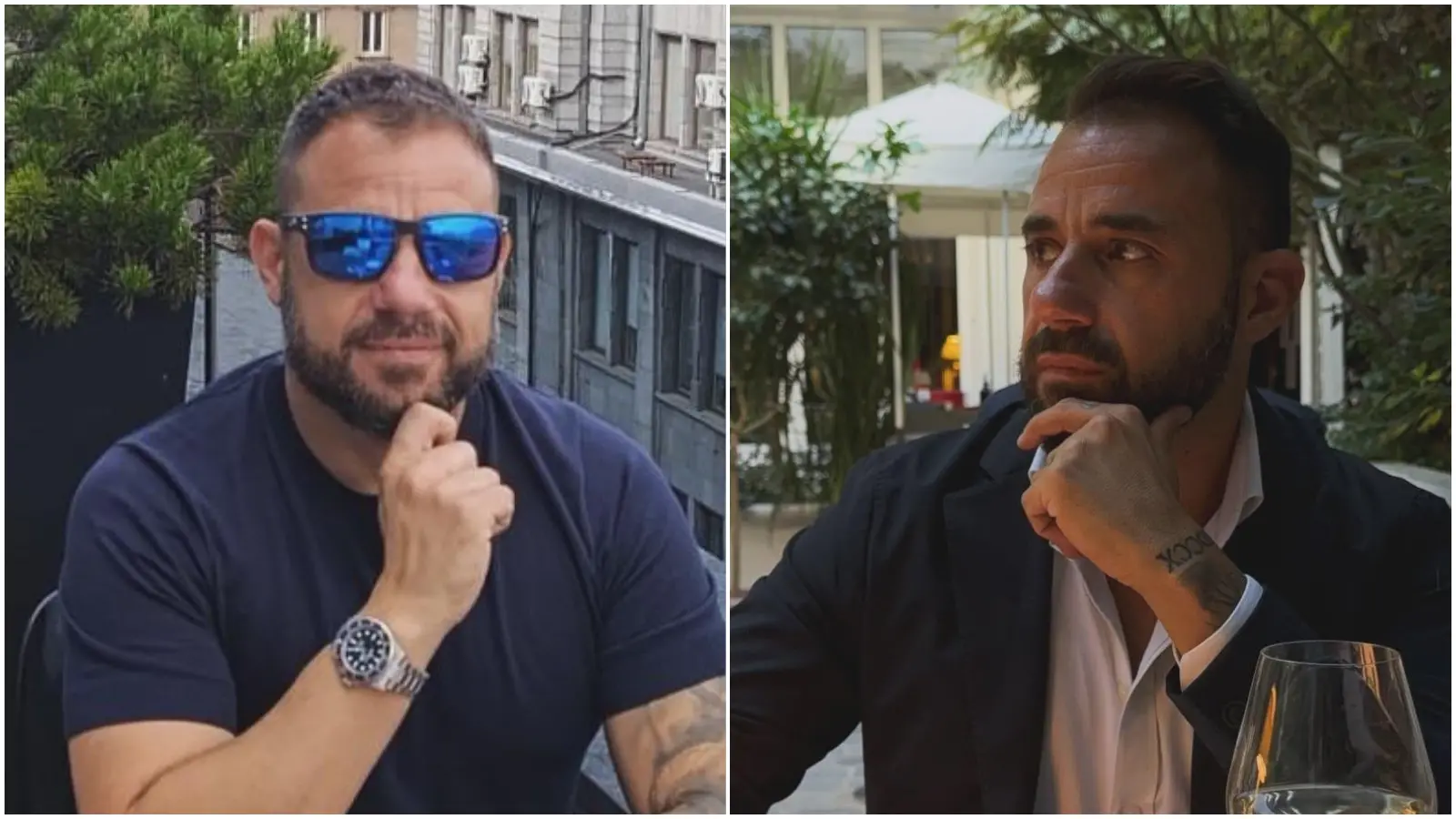
Alex Pineschi had already crossed the dangerous area when part of his unit fell behind.
That is the account his father, Andrea Pineschi, said he received from one of Alex’s colleagues. Alex went back for the men. A Russian drone struck the group near Lyman on May 23, 2026, killing them.
Three years earlier, Alex had explained to me the rule he thought should govern anyone who volunteered for somebody else’s war.
“My first concern was to don’t be a problem for someone else.”
Alex was my friend. In March 2023, I recorded a conversation with him about the five years he had spent fighting ISIS alongside Kurdish forces in Iraq. We talked about Mosul, Kirkuk, drones, foreign volunteers and what happens when danger becomes normal. The episode was published on March 23, 2023.
But we also talked about Italy. When I told him how much I liked the country, he immediately told me that the next time I came he would take me to Cinque Terre. Later, after describing things most people would consider extraordinary, he stopped to make a different point. Sometimes, he said, it takes more courage to wake up in the morning and figure out how to pay the bills than it does to go to war. That was Alex. He could talk about being shot in Kirkuk and then remind you that ordinary life demanded its own kind of courage.
He kept returning to usefulness. A foreign volunteer had no right to assume that showing up with a rifle made him valuable. The first obligation was to understand what the unit needed and become useful to it.
That idea ran through his years in Iraq. It also makes his decision to go to Ukraine easier to understand.

Be Useful First
Alex came from La Spezia and had served in Italy’s Alpini before moving into private security. He later worked armed maritime security off Somalia. In our interview, he told me that by 2014 he had begun studying the rise of ISIS and the Kurdish forces fighting it.
He decided to go.
By 2015 he was in Iraqi Kurdistan. Contemporary reporting by Fausto Biloslavo later found him on the front south of Kirkuk and confirmed the basic path Alex described: former Alpino, maritime security work, then volunteer service alongside Kurdish forces against ISIS.
No unit was waiting for him.
Alex said he spent weeks moving between military and police bases asking commanders to let him help. They repeatedly turned him away. He offered to train people.
He cleaned weapons. He handled basic work. He taught firearms skills. Biloslavo later reported that Alex spent months on probation before being accepted as an instructor with Task Force Black, a Kurdish police special unit.
Alex remembered the process as longer and rougher. He said it took close to a year before Kurdish commanders trusted him with the men and responsibilities he wanted.
“You can find many people ready to pull the trigger,” he told me. “But it’s hard to find someone that can manage and build.”

The Work Beneath the Fight
When Alex described what he had actually done in Iraq, he spent surprisingly little time talking about shooting.
He talked about communications, logistics, training and procedures.
The Kurdish forces he encountered had men willing to fight. Coalition support was bringing weapons and equipment into the war. Alex believed some units still lacked basic systems for organizing those resources.
He described helping write standard operating procedures, organize training, improve communications and establish routines that could be repeated after he was gone. He selected men, trained them, then went into the field with them.
“The most useful part of my duty” was building that structure, he told me.
His criticism of some Western volunteers came from the same experience. He had met foreigners who arrived without understanding Kurdistan, the units they were joining or the work those units actually needed done. Some, he believed, mainly wanted to get into a fight.
If people needed weapons cleaned, he expected a volunteer to clean weapons. If commanders needed somebody to train their men, train them. If the problem was logistics, work on logistics.
Combat came later.
Alex participated in the opening phase of the Mosul campaign in October 2016. Days after that offensive began, ISIS launched a coordinated assault inside Kirkuk.
Alex remembered the attack as something ISIS had prepared for weeks. He said militants had quietly stored ammunition, food, water and medical supplies inside buildings across the city. Then they attacked roughly twenty sites at once.
An electrical facility was hit. So were hotels and government buildings.
One of the positions was a school.
Alex’s unit had been operating around Mosul when it was ordered back to Kirkuk. He said his team was sent to the school, where ISIS fighters were entrenched inside.
His unit was essentially a police special operations force. It did not have the heavy support that would normally make clearing a defended building easier.
The fight became close.
During movement between positions, rounds struck a wall near Alex. Fragments or ricochets hit his left leg.
His first reaction was irritation.
He had recently bought an expensive pair of combat pants and thought the rounds had ruined them.
He laughed when he told me the story. What interested him more was the fact that he had not immediately understood he was wounded.
After years in a war zone, his sense of danger had changed. He said fear never disappeared, but people adapted to it. Events that would have terrified him at the beginning eventually became routine enough that getting hit registered only after he noticed blood on his pants.
That was why he had become skeptical of long deployments. The longer someone remained inside that environment, he believed, the easier it became to misjudge danger because danger had become ordinary.

Coming Home
Alex told me he remained in Iraq until 2019, as the war shifted from large offensives toward raids, searches and operations against smaller ISIS cells.
Then his mother died.
He came home and found himself dealing with a life he had largely left behind.
In Iraq he had been surrounded by the same men every day. They ate together, trained together, fought together and lived with the same risks.
Back in Italy he was alone with grief, bureaucracy and the practical problems of starting over.
Italian authorities had also examined his work in Kurdistan. Prosecutors in La Spezia investigated whether his activity could constitute mercenary service. The prosecutor later requested that the case be dismissed, with reporting at the time distinguishing his volunteer service from mercenary activity.
Alex remembered the investigation as one more part of a difficult return.
He told me he went from helping lead men in Iraq to working security at a supermarket.
“I can be more than that,” he remembered thinking.
So he started again.
He learned how to run a business. He studied psychology. He built AP TAC Tactical Training and eventually operated a range in northern Italy.
Months before he entered Ukraine, Alex published a video about what happened after men like him came home.
“Nessuno ti insegna a tornare dalla guerra.”
No one teaches you how to come back from war.
The video was posted on November 10, 2025. Alex wrote about going from gunfire to the silence of a room, trying to sleep after years of remaining alert, and discovering that war could remain inside somebody after the mission itself ended.
He knew what returning from one war had cost him before he chose another.

Ukraine
Ukraine had already come up when we spoke in 2023.
Alex had watched foreigners travel there after Russia’s full scale invasion. His advice was the same advice he gave when discussing Kurdistan.
Before going, determine whether you have something useful to offer.
“If you go there and you have no experience and you don’t have like the right line to follow, you will not be help,” he told me. “You will be one to manage for someone else.”
In a public video in August 2024, Alex said he did not feel the war in Ukraine was his war.
By the end of 2025, that position had changed.
His father later told La Nazione that Alex left Italy in December 2025 to train personnel destined for the Ukrainian front in a neighboring Eastern European country. In early February 2026, Andrea said, Alex called and told him he had followed the group into Ukraine and was training soldiers in the Donbas. La Nazione independently reported the December departure during the later repatriation of his body.
Public reporting about his exact Ukrainian unit remains inconsistent. Italian outlets identified the 8th Special Operations Regiment, while his father described the formation as a special unit involved in intelligence and drone warfare. Ukraine’s own material places the 8th Regiment within the Armed Forces’ Special Operations Forces.
No public Ukrainian service record tying Alex personally to the regiment has been located. The exact unit attribution should remain unresolved.
What happened near Lyman is clearer.
According to the account his father said he received from one of Alex’s colleagues, the group was returning from an operation on May 23 when several men fell behind.
Alex had already crossed the dangerous area.
He went back.
A drone struck the group and killed them.
Alex had also prepared a message to be delivered to his father if he died. In it, he explained that he had been able to leave Ukraine but chose to remain because what he had seen there conflicted with his principles.
That is the closest the public record gets to explaining why a war Alex had rejected in 2024 became one he was willing to die in less than two years later.

Home
Getting Alex home became another operation.
His body left Kyiv in June and was transported overland to La Spezia in a funeral convoy. The family had initially been told that the cost of the international transfer would fall on them.
Friends opened a fundraiser for Andrea Pineschi.
It raised €17,461 from 637 donations.
Alex reached La Spezia on June 12.
His funeral was held on June 15 at the Sant’Antonio da Padova sanctuary in Gaggiola. The church was full. The coffin was covered with the Italian flag. His Alpino cap sat on top beside a photograph of him.
Andrea read the Alpini prayer.
Then he spoke about his son.
Others knew him as Alex. His father called him Alessandro.
“He was a great idealist,” Andrea said. “You can call him a hero if you want, but to me he was my son.”
Alex’s friends carried the coffin out of the church.
When we spoke in 2023, Alex told me that his first concern when entering Kurdistan had been avoiding becoming a burden on the people already fighting.
According to the account his family received, his last decision near Lyman was to go back for men who had fallen behind.
What did Alex see in Ukraine that made the war his?
John Hendricks is an OSINT analyst and the founder of Global Recon. Follow on X: @IGRecon