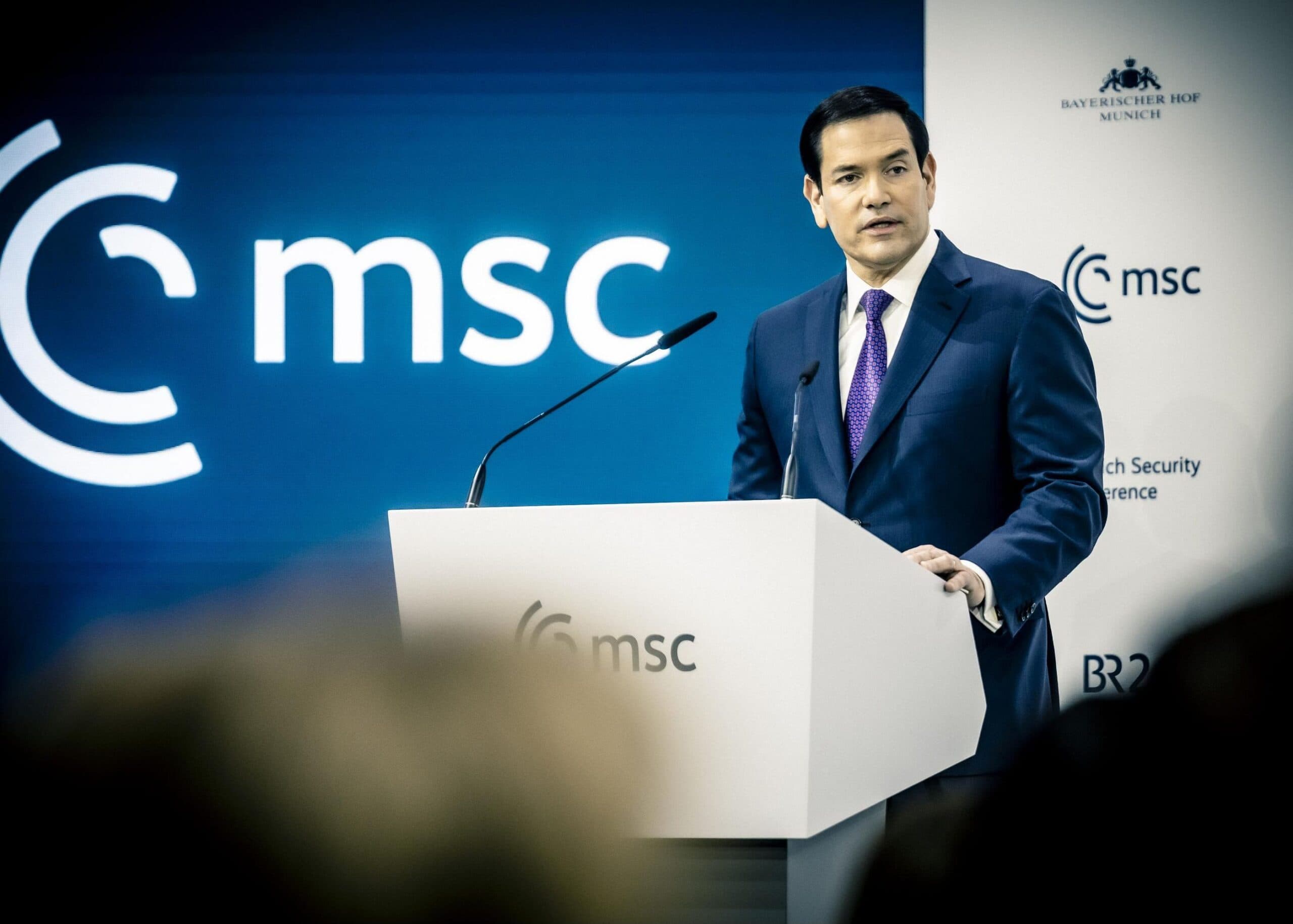
Watching Marco Rubio address the Munich Security Conference last week, I kept thinking about the gap between presentation and substance. His speech was warm, historically grounded, and emotionally resonant. The room rewarded it with a standing ovation. European officials described it as “reassuring.”
And yet, when Belgian Defense Minister Theo Francken was asked about the speech immediately afterward, his response was disarmingly blunt: what Rubio said and what J.D. Vance had said a year earlier amounted to the same message just delivered differently.
That distinction matters. Because if the substance is unchanged and only the delivery has softened, then Europe’s relief tells us more about European psychology than about American policy.
The postwar settlement is over. What Munich 2026 revealed, beneath the applause and polite optimism, is that Europe is only now beginning to reckon with what that reality entails. For decades, American security guarantees did more than deter adversaries. They insulated European political systems from hard tradeoffs. The result was not merely peace, but a sustained illusion of consequence-free governance.
Europe represents roughly 7 percent of the world’s population and 25 percent of its economic output, yet accounts for more than half of global welfare spending. That imbalance did not emerge by accident. It was made possible by an American security umbrella that allowed European governments to expand social spending, scale back military capacity, and treat defense as a secondary concern all while assuming the strategic environment would remain benign.
They were warned otherwise. In 2018, Donald Trump told the German delegation at the United Nations that continued reliance on Russian energy would create strategic dependency. The delegation laughed. The moment captured the prevailing worldview among Europe’s leadership at the time: great-power competition was over, globalization had dissolved old threats, and energy could never again be wielded as a weapon.
Then 150,000 Russian troops crossed into Ukraine. The laughter stopped.
The invasion shattered more than Europe’s energy assumptions. It exposed the fragility of the post-Cold War consensus that had underwritten European policymaking for a generation. A continent that had expanded its welfare state, opened its borders, and reduced its military capacity suddenly found itself confronting a world it no longer had the tools political or material to manage.
The strain was already visible. The migration crisis that followed the 2015 wave had transformed European societies faster than governments were willing to admit. Ukraine accelerated a reckoning that had been deferred for years. You cannot tell a working-class voter in Germany or France that pension reform is unavoidable while insisting that large-scale migration is cost-free and culturally frictionless, and expect that argument to land without political consequences.
Now the arithmetic is unavoidable. Germany’s defense spending is projected to rise from roughly $53 billion in 2020 to nearly $190 billion by 2029. NATO’s proposed target of 5 percent of GDP by 2035 would consume an estimated 42 percent of Germany’s total government budget. Chancellor Friedrich Merz has warned his own party that the welfare state, as currently structured, cannot be financed under these conditions. His center-left coalition partner responded with a single blunt obscenity.
This moment was always coming. A society cannot indefinitely outsource its security, expand its welfare commitments, manage migration loosely, and assume the world will remain stable enough to make the math work. European governments made those choices. For decades, American guarantees rendered them consequence free.
The political fallout is only beginning to surface. Center left parties spent years assuring voters that social spending was untouchable. Center right parties promised fiscal discipline while quietly relying on Washington to shoulder defense obligations. Both positions are now untenable, and neither camp has articulated a credible path forward.
This is the terrain on which populist movements thrive, and it is not difficult to understand why. European governments chose to open their borders at a scale their societies were not prepared to absorb, then refused to enforce even minimal expectations of integration. The result, in too many places, is a public that feels it has been asked to subsidize its own transformation while being told that voicing concern is illegitimate.
Europe’s culture is worth defending. That is not a radical claim. It is, in substance, the same argument Rubio was making in Munich expressed in diplomatic language. The continent that produced the rule of law, the scientific revolution, and centuries of art and philosophy did not build that inheritance to see it diluted by governments too cautious to enforce reasonable standards of cohesion.
Rubio closed his speech with a call to renewal. Yesterday is over, he said. The future is inevitable. Our shared destiny awaits. The room stood and applauded. He was right that yesterday is over. Where the applause felt premature was in the assumption that what comes next is a reinvigorated alliance of equal partners.
Europe is not yet an equal partner. It has the wealth, population, and industrial potential to become one. But decades of deferred decisions have left it strategically dependent in ways that cannot be reversed in a single budget cycle. Rearmament is real. Urgency is genuine. But urgency does not equal capability.
I believe in the alliance Rubio described. Watching him invoke his Spanish and Italian heritage in Munich speaking as America’s chief diplomat to a room full of Europeans underscored that the Atlantic story is shared. That inheritance is worth preserving. But preserving it honestly requires acknowledging what enabled the drift in the first place.
For eight decades, the United States did not merely defend Europe. It subsidized Europe’s choices about welfare, borders, and priorities. Some of those choices produced extraordinary achievements. The reckoning now underway is not punishment. It is reality, arriving on schedule.
If Europe rises to meet it, the alliance Rubio envisioned becomes possible. If it does not, Munich 2026 will not be remembered as a moment of reassurance, but as the last comfortable pause before a far harder adjustment set in.