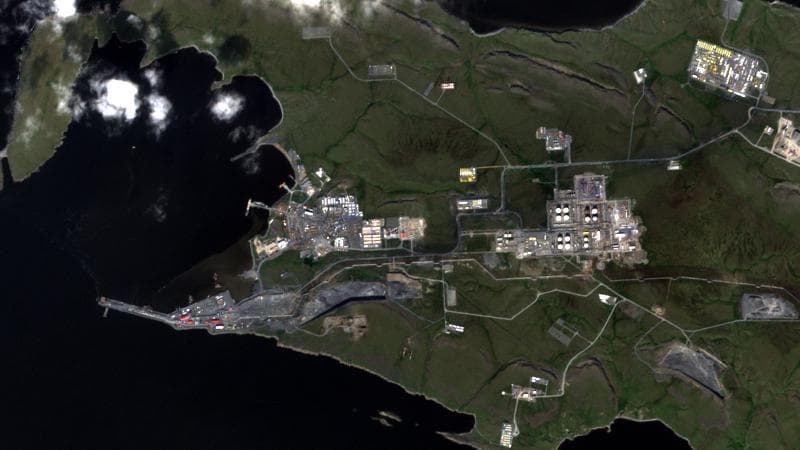
What Rosneft opened
The numbers Rosneft released are specific. The pipeline is rated for 100 million tonnes a year, a design figure rather than a demonstrated one. The port has a single oil loading berth able to take tankers of around 120,000 deadweight tonnes, plus two cargo berths and a berth for the port fleet. Fourteen tanks of 30,000 tonnes each are built, out of a planned 102. Sechin told Putin more than 2,000 wells are online. This is phase one of a project Rosneft values at four trillion roubles and calls the largest oil development in Russia since West Siberia. The first cargo went into the Valentin Pikul. The Aframax Akademik Gubkin was waiting at anchor to take the second. Deputy Prime Minister Alexander Novak said the terminal would supply customers in both the West and the Asia-Pacific.The two ships at the berth
The Valentin Pikul, IMO 9885879, is a 69,323 deadweight tonne shuttle tanker, 257 metres long, built at the Zvezda yard near Vladivostok. Rosneft’s release and the Kremlin transcript call it an Arc7 vessel. The Russian Maritime Register lists it as Arc6, built December 2024. The register governs where the ship can go, and Arc6 is what it is: independent operation in first-year ice up to about 1.5 metres, with an icebreaking stern for running astern through heavier floes. It is also not a Vostok Oil ship by origin. Rosneft’s May 2018 release announced it as an Arc6 shuttle tanker for exports from the Trebs and Titov fields in the Nenets district, and Ukraine’s GUR sanctions database records its assignment as the Varandey to Murmansk shuttle in the Pechora Sea. It was laid down in December 2020, launched in July 2023, and handed to Rosnefteflot in January 2025, roughly seven years after the order. Samsung Heavy Industries designed it and supplied hull blocks; Zvezda assembled it. Whether it had started the Varandey run before Rosneft sent it north is not established. What the documents establish is that this high-ice hull was assigned to one field and is loading at another. The Akademik Gubkin, IMO 9842190, is a different kind of ship. Rosneft’s release when it went to sea trials in April 2023 describes a 114,000 deadweight tonne Aframax with ICE-1A notation, designed for unrestricted navigation. ICE-1A is a Finnish-Swedish Baltic class rated for first-year ice of around 0.8 metres with icebreaker assistance. It does not qualify a ship for independent winter navigation in the Kara Sea. Since delivery the Gubkin has worked conventional trades: in January 2025 it loaded 100,000 tonnes of Urals at Ust-Luga for Cuba, according to vessel-tracking reporting, and GUR logged it in ship-to-ship transfers off the Cuban coast. It is at Bukhta Sever because September is open water. Both hulls were identified by OFAC on 10 January 2025 as Rosnefteflot property, in the action that also blocked the company. Rosneft itself went on the SDN list on 22 October 2025. The EU listed the Valentin Pikul on 24 April 2026 under its shadow-fleet article. The first cargo out of Russia’s newest export terminal left on a ship sanctioned by Washington, London, Ottawa and Brussels, and the second went into a ship sanctioned by Washington. That is the operating condition, not an obstacle to it.The fleet Rosneft promised
Rosneft’s fourth-quarter 2021 results presentation, published in February 2022, put the transport plan on one slide. Construction of ten Arc7 oil tankers was underway at Zvezda. The first would be ready in 2024, two more in 2025, three in 2026 and four in 2027. The same slide projected Northern Sea Route traffic of up to 30 million tonnes in 2024, 50 million in 2027 and 100 million in 2030. Measured against that slide, three Arc7 tankers should have existed by the end of 2025 and six by the end of 2026, and 30 million tonnes should have moved two seasons ago. Nine months into 2026 there is one Arc6 hull ordered under a different programme, and a 30 million tonne target that has slipped three years to the second half of 2027. The ten-ship series depended on South Korea. In October 2021 Zvezda contracted Samsung Heavy Industries to supply design, equipment and hull blocks for seven icebreaking shuttle tankers, alongside an earlier contract for ten LNG carriers. Samsung’s account, filed with the Korean exchange, is that the US designation of Zvezda on 23 February 2024 blocked transactions with the yard, that Zvezda cancelled both contracts in June 2024 and demanded repayment of advances, and that Samsung filed for arbitration in Singapore in July 2024. On 18 June 2025 Samsung terminated from its side, retaining 200 million dollars received against the shuttle tankers and claiming damages beyond that. Those are Samsung’s claims in an arbitration still open. The industrial fact beneath them is that the contracted source of blocks and design documentation for seven Vostok shuttle tankers ended two years ago. Zvezda’s record on Arctic hulls since then is two LNG carriers and no tanker from the cancelled order. The Aleksey Kosygin, the first Russian-built Arc7 gas carrier, was handed to Sovcomflot on 24 December 2025 with Putin on the link, four years after it was laid down and with Samsung-built blocks in its hull. The second, Konstantin Posyet, was named on 18 June 2026 and loaded its first cargo at Arctic LNG 2 on 30 August, per the Barents Observer. Both went to Novatek. Neither carries crude, and Bellona assesses the Posyet as probably the last Zvezda hull whose critical foreign components arrived before sanctions. The yard’s Leader-class nuclear icebreaker, meant to keep the eastern route open in winter, is not expected to launch before 2030, per gCaptain.
The arithmetic of one hull
Thirty million tonnes a year is about 600,000 barrels a day. Ronald Smith of Emerging Markets Oil and Gas Consulting Partners, quoted by S&P Global after the ceremony, estimates the Valentin Pikul working alone could move around 50,000 barrels a day year-round, shuttling west to Murmansk for transfer to conventional tankers. That is roughly eight percent of the phase one target from the only winter ship at the berth. Smith’s other line governs the next month: the Northern Sea Route starts closing in the first week of October, and after that oil flows are defined by the size of the ice-class fleet. Until freeze-up, conventional tonnage can lift direct, and the Gubkin is doing that now. Novak’s reference to Western customers is the winter route in plain language: Kara Sea to Kola Bay, ship-to-ship in the Murmansk roads, then whatever hull will carry sanctioned Russian crude onward. That is the architecture Novatek uses for Arctic LNG and Lukoil uses for Varandey, so every winter barrel from Vostok Oil enters the same shuttle and STS bottleneck they already compete for. Public AIS does not show where the first cargoes went. On 7 September the free VesselFinder pages for both hulls displayed positions months old, with the Gubkin’s declared destination reading Sever Bay and the Pikul’s last public fix dating to the previous winter. Those are aggregator records with their dates attached. They establish a visibility gap, and the export line opened inside it. There is a counter-read. Russia has other high-ice crude shuttles: Sovcomflot’s Arc6 Vasily Dinkov class, which its fleet history ties to the Varandey service, and the Arc7 Shturman class that serves Gazprom Neft’s Novy Port. Rosneft could charter them, and the Pikul’s own reassignment shows the state will move hulls between projects. What is not established is whether any are free, and if they are not, moving them relocates the shortfall rather than closing it. The constraint may also sit upstream: Bellona’s August digest quotes Sechin putting initial terminal capacity at 28.4 million tonnes and notes trial production is running at one section of Payakha, with no Rosneft figure for what the fields can deliver. Rosneft’s 2021 schedule said the fleet would be three ships deep last year. The yard delivered gas carriers instead.
What the port changes
Sanctions on Vostok Oil aimed at the operating company and its contractors, and the terminal got built anyway. Where they landed was in Geoje, South Korea, on a block-supply contract, and that is where the project’s constraint now lives. A pipeline rated for 100 million tonnes ends at a berth Rosneft has one ship to serve in January. The consequence is a queue for the yard. Zvezda has completed three large Arctic hulls since December 2024, all built on Samsung blocks, and Bellona assesses the Posyet as probably the last one with foreign components on board. Whatever it builds next without them is contested between Vostok Oil’s crude shuttles, Novatek’s gas carriers and the icebreaker programme. Putin told the ceremony Russia would add four nuclear icebreakers by 2030. Icebreakers clear channels for tankers that have to exist first. The near-term indicator is simple to watch. If a third crude tanker of any ice class appears at Bukhta Sever before the route closes in October, the summer lift is larger than the two announced ships. If the Valentin Pikul reappears on AIS in Kola Bay in November or December discharging to another hull, the Murmansk shuttle is running. The fourteen tanks hold about five days of the 2027 target. That is the buffer if the winter run stays at one hull. Rosneft is promising 30 million tonnes a year from a coast where the sea freezes in October, on a fleet plan that ended in a Singapore arbitration, with one ship that it borrowed from another field.John Hendricks is an OSINT analyst and the founder of Global Recon. Follow on X: @IGRecon