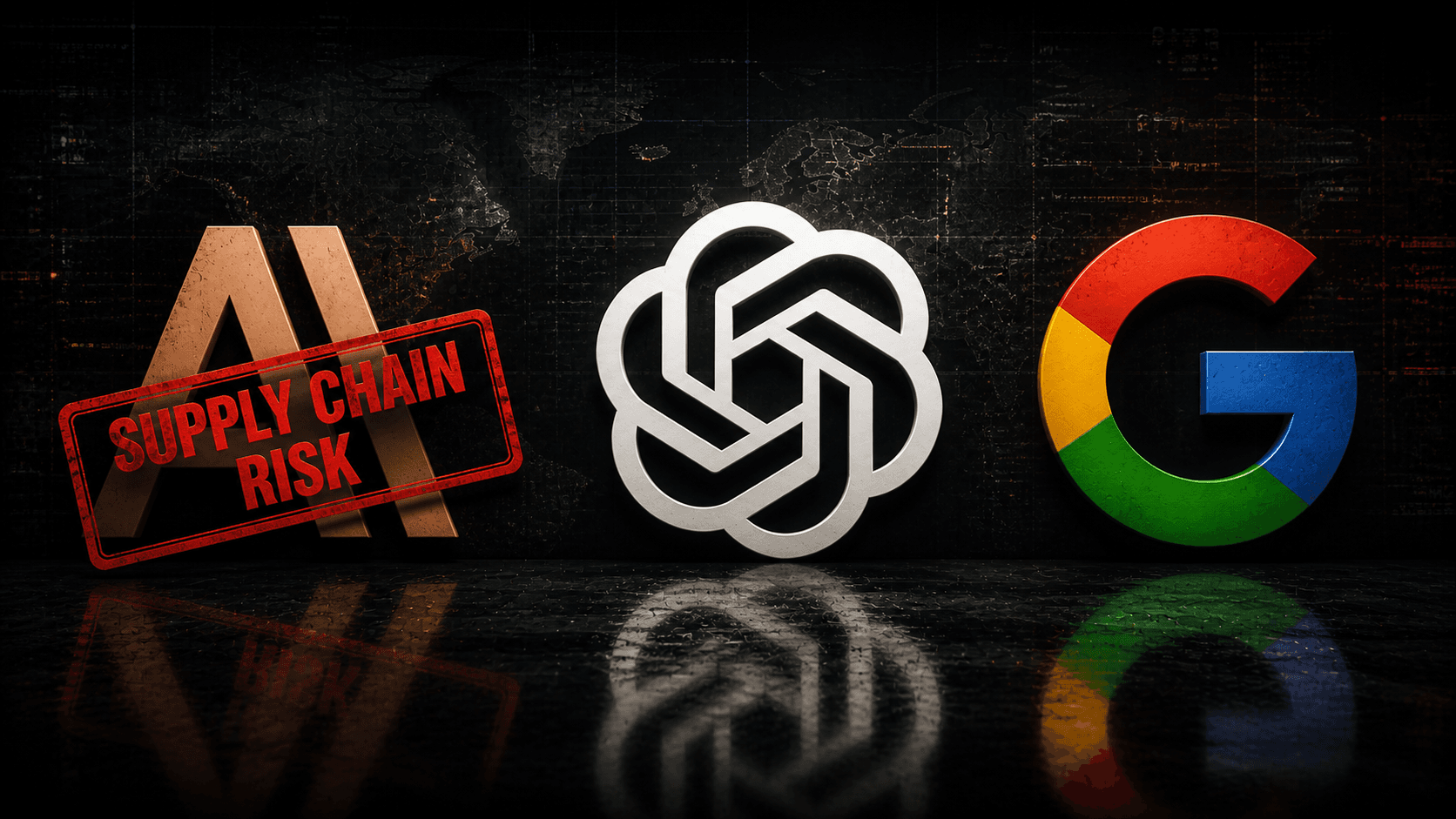
Eleven days separated the purge from the lock-in.
On February 27, 2026, Defense Secretary Pete Hegseth designated Anthropic a supply chain risk and ordered the company’s products phased out across the Department of Defense within six months. On March 9, Deputy Secretary of Defense Steve Feinberg signed a four-page memo turning Palantir’s Maven Smart System into a permanent program of record. One move removed a frontier AI lab that refused the Pentagon’s terms. The other made the targeting substrate permanent.
Most coverage treated these as two separate stories. They are the same story, viewed from different layers.
Artificial intelligence has become the operating system of US joint command and control, and the architecture that delivered it was built deliberately. The Feinberg memo institutionalized the substrate. The Anthropic designation disciplined the vendor base. Both were the product of a procurement framework the Pentagon spent the previous eighteen months constructing. The federalization of commercial AI infrastructure that an earlier piece in this series traced through the energy lane is now visible in the targeting lane. Same mechanism, different layer.
Commercial AI capability has been pulled into a defense-controlled framework through procurement architecture, program-of-record consolidation, and a legal carve-out that exempts decision-support systems from the autonomous-weapons review process entirely. The kill chain has been classified. Not in the sense of secrecy. In the sense that it is now a managed federal asset.
What Is Visible
Maven Smart System is the AI substrate fusing data from satellites, drones, radars, signals intelligence, and human reporting feeds into a single command-and-control interface. CDAO director Cameron Stanley has publicly stated that Maven raised target processing rates from under 100 per day to 1,000 per day with computer vision integration, then to 5,000 per day after large language model integration. CENTCOM commander Adm. Brad Cooper credited the system in his March 11 video briefing on Operation Epic Fury, where US forces struck more than 13,000 targets across 38 days according to White House operational accounting released on April 8.
Per Palantir’s own program documentation, Maven is deployed at production level across CENTCOM, EUCOM, INDOPACOM, NORAD/NORTHCOM, SPACECOM, TRANSCOM, AFRICOM, and the Joint Staff, with additional deployments at CYBERCOM, STRATCOM, and SOUTHCOM. NGA Director Vice Adm. Frank Whitworth confirmed in May 2025 that more than 20,000 active Maven users were operating across more than 35 service and combatant command tools in three security domains, with the user base having more than doubled since January. The Marine Corps signed an enterprise license in August 2025. NATO signed a separate version, MSS NATO, supporting Allied Command Operations. The system is no longer experimental, and it is no longer optional.

The IDF’s Gospel and Lavender systems, operated by Unit 8200, are functional predecessors of the same decision-support category. Their wartime use in Gaza from October 2023 onward demonstrated the operational concept at scale. The Pentagon was watching.
The Substrate Was Made Permanent
The Feinberg memo, dated March 9, 2026, runs four pages. It contains three structural moves.
Maven Smart System becomes a program of record by the close of fiscal year 2026, on September 30. Oversight transfers from the National Geospatial-Intelligence Agency to a newly constituted CDAO MSS Program Office within 30 days. All MSS contracts move to the existing Army Enterprise Agreement vehicle, the same contracting structure used for the rest of Palantir’s joint enterprise work.
Each of these moves is bureaucratic in isolation. Together they constitute the institutional moment where AI targeting stops being an experimental capability and becomes the default substrate for joint command and control.
Program-of-record status secures stable, multi-year funding. It establishes a single program office accountable for enterprise-wide integration. It creates a centralized authorizing official under the Office of the Under Secretary of Defense for Research and Engineering. The contract trajectory tracks the institutional consolidation. A $480M IDIQ in May 2024. A $1.3B ceiling expansion through 2029 in May 2025. Consolidation under the Army Enterprise Agreement in March 2026. Of the eleven combatant commands, four have confirmed on the record to DefenseScoop that they received the transition directive: Northern Command, Transportation Command, Special Operations Command, and Space Command. The rest declined comment citing operational security.
The earlier institutional history matters. Maven was launched in 2017 as the Algorithmic Warfare Cross-Functional Team. It moved between OUSD(I), the Joint Artificial Intelligence Center, NGA, and CDAO across three administrations. The tripartite arrangement after the 2022 split was, per a former senior defense official quoted by DefenseScoop, a governance problem because no single official could be held accountable. The Feinberg memo collapsed that structure into one office under one chief.
The memo did not authorize anything new. It made what was already operational impossible to roll back.
Combined Joint All-Domain Command and Control, the Pentagon’s stated framework for fusing sensors, decisions, and effectors across all domains, is being routed through Maven Smart System. The memo states that AI-enabled decision-making is the cornerstone of the department’s strategy for CJADC2. That sentence is the institutional commitment. In practice, CJADC2 is being routed through Maven, and Maven is being consolidated around Palantir.

The Legal Architecture Permits It
Nothing about the institutionalization of Maven required a legal carve-out, because the legal carve-out already existed.
DoD Directive 3000.09, last updated in January 2023, is the governing US policy on autonomous weapons. Three structural features make it elastic by design.
The first is scope. The directive covers systems that select and engage targets autonomously. Decision-support systems that generate target lists for human approval are explicitly outside its scope. Maven Smart System is not, in regulatory terms, a weapon system. It is a planning and analytical tool. The directive does not apply to it.
The second is the standard. The directive requires that systems be designed to allow appropriate levels of human judgment over the use of force. A 2018 US government white paper on the standard, submitted to the UN Group of Governmental Experts on Lethal Autonomous Weapons Systems, states that what counts as appropriate varies across weapon systems, domains of warfare, types of warfare, operational contexts, and even across different functions in a weapon system. The standard adapts to the operational context rather than constraining it.
The third is the waiver. For systems that do fall within scope, the senior-level review process can be waived by the Deputy Secretary of Defense in cases of urgent military need. Section 1061 of the FY2026 National Defense Authorization Act newly requires congressional notification of any such waiver. That Congress now requires notification suggests Congress anticipates one.
NATO operates in parallel. The 2021 NATO AI Strategy, revised in 2024, commits allies to six principles of responsible use including lawfulness, accountability, and governability. Enforcement is tied to existing international humanitarian law rather than new binding obligations. The EU AI Act explicitly excludes military applications from its scope. Allied Command Transformation’s Political-Military Assisted Decision Making initiative sits in the same decision-support carve-out as Maven. The framework was designed to operate consistently across peacetime and wartime. That consistency is the wartime adaptation.
The structural point: the question of what changes legally during wartime assumes a framework built to resist accommodation. The actual framework was built to accommodate. The rules that govern Maven at 5,000 targets per day are the same rules that governed it at 100 per day. Wartime did not break the rules. The rules already permit what wartime requires.
The Procurement Channel Was Built and Then Purged
Making the substrate permanent solved only half the problem. The harder task was governing the vendor base.
In July 2025, CDAO awarded $200M-ceiling Other Transaction Agreements to four frontier labs: Anthropic, OpenAI, Google, and xAI. The structure was deliberate. Multi-vendor optionality. Two-year prototype agreements. Mission scope spanning agentic workflows, classified deployment, and warfighting support. Pentagon CTO Emil Michael said publicly on CNBC that the architecture was designed so the department would not be reliant on any one partner. That sentence is the disciplining principle stated plainly.
In December 2025, GenAI.mil launched as the enterprise platform for Impact Level 5 authorized generative AI access across the department. The platform routes department users to multiple commercial models through a single classified gateway. Vendor swap-out becomes a matter of routing configuration.
In February 2026, a dispute between Anthropic and the Pentagon over Claude usage in the Venezuela operation became public. On February 27, OpenAI announced an agreement with the Department of War committing the company to all lawful uses of its models in defense contexts. The same day, Hegseth designated Anthropic a supply chain risk, a designation typically reserved for foreign adversaries, and ordered Anthropic products phased out across DoD within six months. The sequence was not coincidental. OpenAI accepted the framework Anthropic was about to be removed for refusing. On April 28, Google authorized its Distributed Cloud and Tensor Processing Unit infrastructure for War Department classified environments. On May 1, the department expanded its classified AI work to eight frontier providers, explicitly excluding Anthropic. Anthropic has sued in federal court. Litigation is active.

The structural mechanism is vendor optionality as discipline. The architecture is built so that any single lab can be removed without breaking the substrate. The contract phrase “all lawful uses” operationalizes the legal elasticity from the previous section. A lab that signs the phrase accepts whatever interpretation the framework permits at any given operational tempo. A lab that refuses the phrase falls outside the framework. Anthropic refused; the channel routed around them in seventy-two hours.
The blacklisting was not a punishment. It was the architecture working as intended.
The pattern matches the federalization mechanism the earlier Infrastructure Intelligence piece traced in the energy lane. Commercial capability pulled into a defense-controlled framework via contract terms, classified deployment requirements, and air-gapped infrastructure. Compute now sits in the same defense supply chain logic that 16 U.S.C. § 824o-1 applies to grid assets. TPUs, Distributed Cloud enclaves, and IL6-authorized AI environments are infrastructure inputs to the warfighting machine in the same sense that transformers and HALEU are. The point is not that compute and grid assets are legally identical. The point is that both are being treated as strategic infrastructure once commercial dependency becomes a defense vulnerability. The lane is the same. The mechanism is the same.
Why It Matters Operationally
The substrate is now durable. Program-of-record status secures funding through at least FY2029. The Army Enterprise Agreement provides the contracting vehicle. The CDAO MSS Program Office provides the institutional home. A new administration cannot easily unwind what is now embedded across the joint force with NATO interoperability. The capability is locked in.
The vendor base is now governable. The Anthropic case establishes the precedent. Frontier labs that refuse all-lawful-uses terms get removed. Other labs read the signal. Future safety-positioned holdouts face the same architecture. The Pentagon has demonstrated that vendor governance can be exercised at the level of supply chain risk designation, which is a structurally different mechanism than contract non-renewal. It applies across the department and propagates to allies and contractors.
The compute layer is the next federalization frontier. Google Distributed Cloud and TPU authorization for classified environments, OpenAI’s classified deployment agreement, and the May 1 expansion to eight providers indicate that commercial compute capacity is being pulled into the same defense-controlled framework as the AI models themselves. The energy lane was federalized first. The targeting substrate is being federalized now. The compute infrastructure that runs both is next.
Conclusion
The conventional framing presents AI in warfare as a question still being decided. It is not. The decisions have been made. The Feinberg memo institutionalized the substrate. The Anthropic designation set the vendor governance precedent. The legal architecture permitted it without modification. The procurement architecture absorbed it without friction. The compute infrastructure is following.
AI did not enter the warfighting machine. The warfighting machine was rebuilt around it.