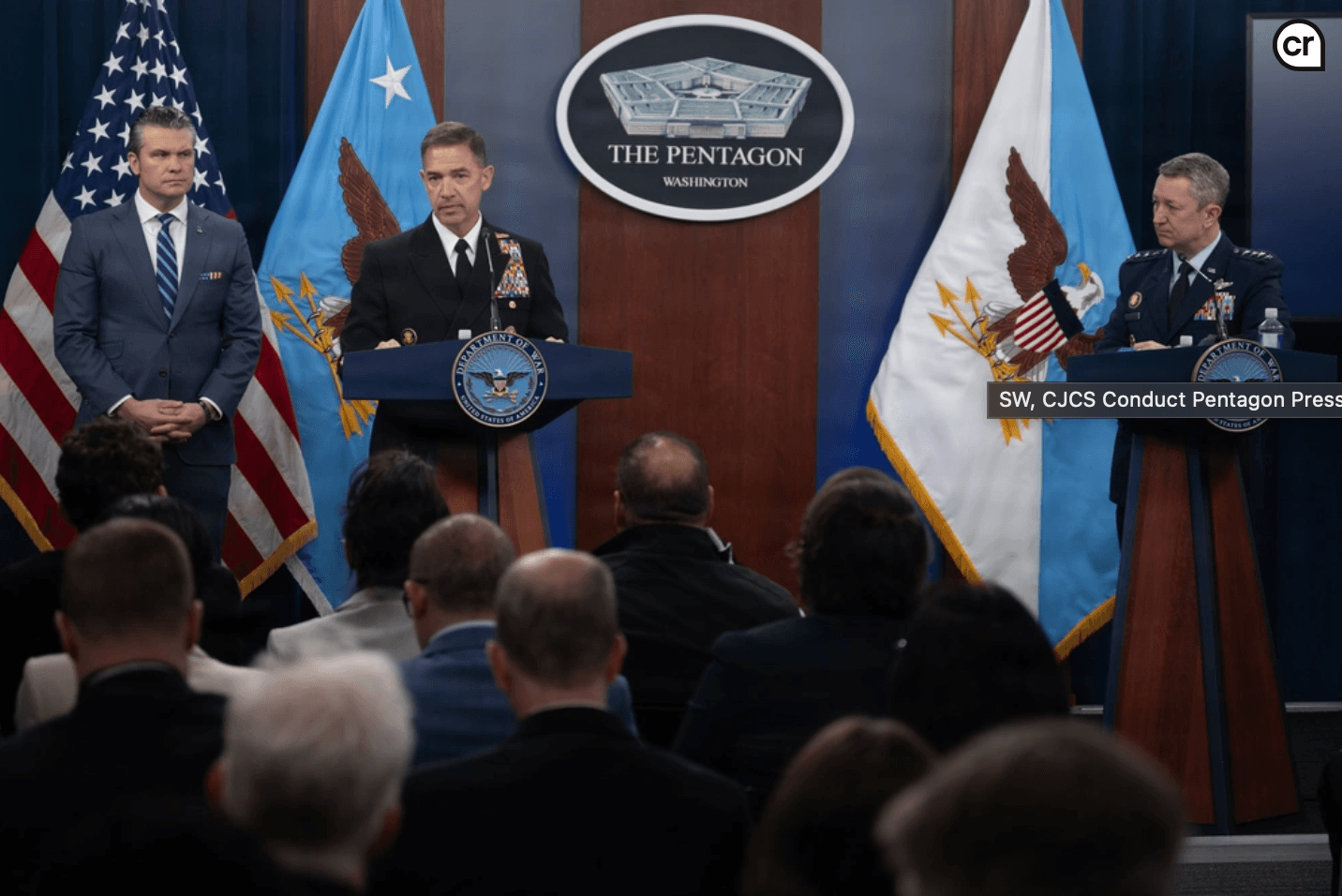
U.S. Central Command on Thursday published an updated advisory asserting the right to board and seize Iran linked vessels regardless of location on the open seas, classifying crude oil, iron, steel, aluminum, machine tools, and dual-use electronics as “conditional contraband” subject to capture beyond neutral territory. Gen. Dan Caine, chairman of the Joint Chiefs, told reporters at the Pentagon that U.S. forces “will actively pursue any Iranian flagged vessel or any vessel attempting to provide material support to Iran.” Lloyd’s List characterized the accompanying contraband list as so expansive it effectively constitutes a total maritime embargo on the Iranian economy.
The doctrine is the story, not the blockade. Conditional contraband historically applies under prize law during declared wars. The U.S. has not declared war on Iran. The advisory is a unilateral assertion of extraterritorial maritime interdiction authority without congressional authorization and without a UN Security Council resolution.
The closest analog is the 1962 Cuban Missile Crisis quarantine, which was authorized by an Organization of American States resolution and deliberately styled as a quarantine rather than a blockade to avoid legal problems this advisory ignores. CENTCOM’s language, goods “subject to capture at any place beyond neutral territory,” is drawn directly from traditional law of naval warfare and carries sweeping geographical implications. Lloyd’s List Intelligence tracking currently shows 109 shadow fleet tankers in the Gulf of Oman and 77 off Malaysia, both standard ship-to-ship transfer hubs for Iranian crude. Those vessels are now nominally inside the capture zone.
The ceasefire framework under discussion in Pakistan cannot rescind this. Operational guidance communicated to commercial shipping does not expire when diplomats shake hands. Insurers and flag states will price this doctrine into every Iran-adjacent transit decision indefinitely, which is what makes the legal architecture more consequential than the blockade itself.