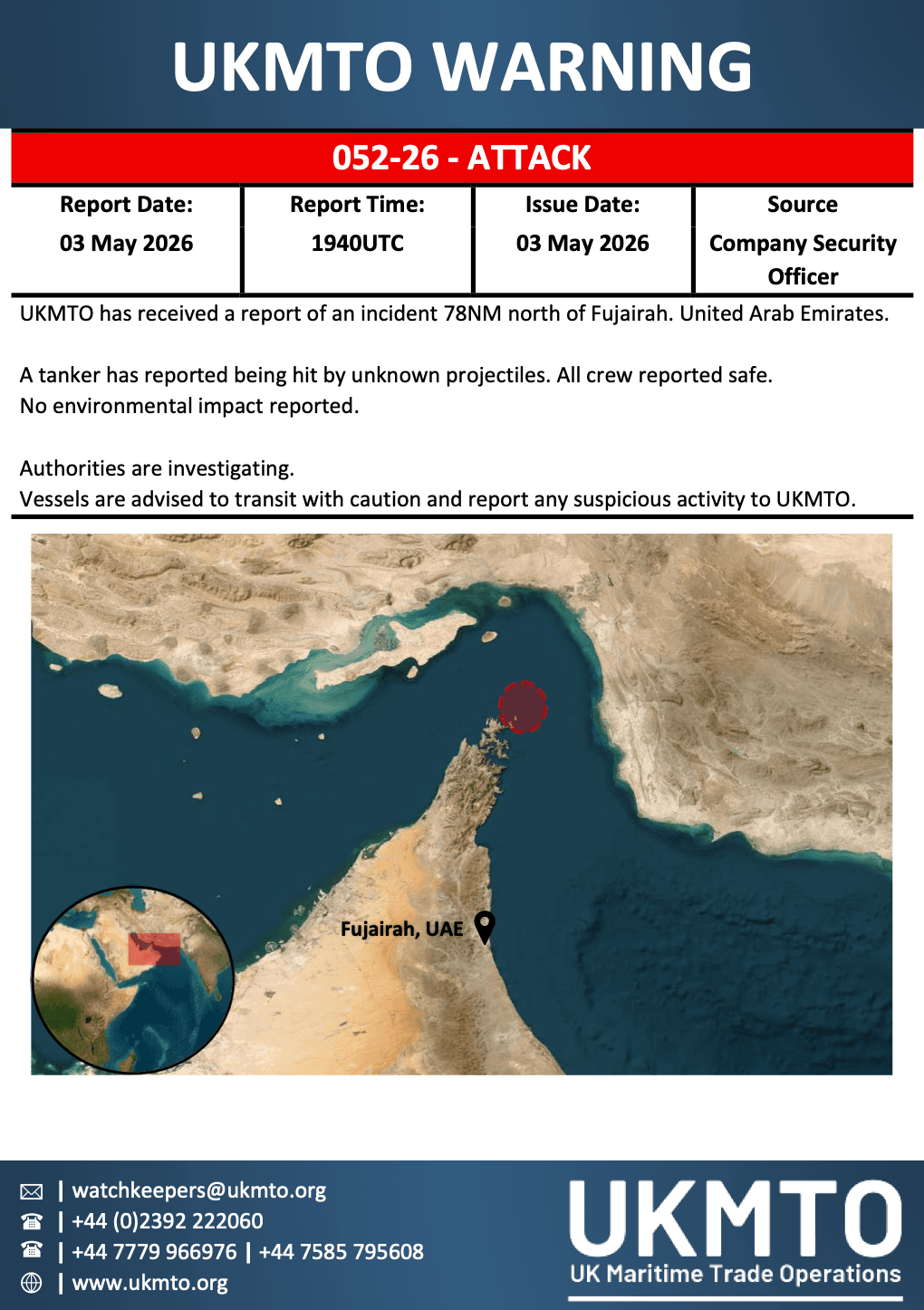
The first test came within hours. ADNOC reported two drones struck its empty tanker Barakah as it transited the strait, and the UAE attributed the attack to Iran. Iran’s navy reported firing warning shots near U.S. destroyers. Axios and the Wall Street Journal, citing two U.S. officials each, reported the operational concept does not include direct naval escort. Navy ships will remain in the vicinity and provide commercial vessels with route guidance through lanes not mined by the IRGC.
This is not Operation Earnest Will. The 1987-88 reflagging operation put U.S. flags on Kuwaiti tankers and warships alongside them. Project Freedom is an intelligence-sharing and route-advisory service with destroyers nearby. The gap between the operation’s name and its operational design is the entire story.
[Image: ADNOC tanker Barakah file image or UKMTO incident location chart. Source: ADNOC / UKMTO. Caption: ADNOC · MV Barakah, struck by two Iranian drones approximately 78 nautical miles north of Fujairah · May 4, 2026.]
CENTCOM announced Monday that two U.S.-flagged merchant vessels transited the strait alongside U.S. Navy destroyers. That proves the U.S. can move U.S.-flagged ships with warships alongside. It proves nothing about the roughly 900 commercial vessels in the Gulf as of late April, per maritime intelligence firm AXSMarine, none of which fly U.S. flags or have destroyers nearby. The actual gatekeeper of Hormuz transit since March has been the insurance market. Lloyd’s List finance editor David Osler placed pre-conflict war-risk rates at 0.15 to 0.25 percent of hull value for a one-week policy. Quotes since February 28 have run as high as 5 to 10 percent. Lloyd’s Joint War Committee has designated the entire Persian Gulf as a conflict zone. Commercial tankers that moved through the strait did so by coordinating directly with Iranian authorities, as Thailand’s Bangchak Corporation did in March. Iranian consent, not U.S. presence, has been the operative variable on insurability.
A proximity posture that avoids physical escort confirms what underwriters already priced. The IRGC’s kinetic response on Day One, against a commercial vessel rather than a U.S. warship, is a direct test of the design. The real test of Project Freedom is not whether U.S.-flagged vessels can move under American cover. They can. It is whether non-U.S.-flagged commercial ships can move without Iranian coordination and remain insurable. That is where deterrence gets priced. Not in the press release. In the war-risk quote.