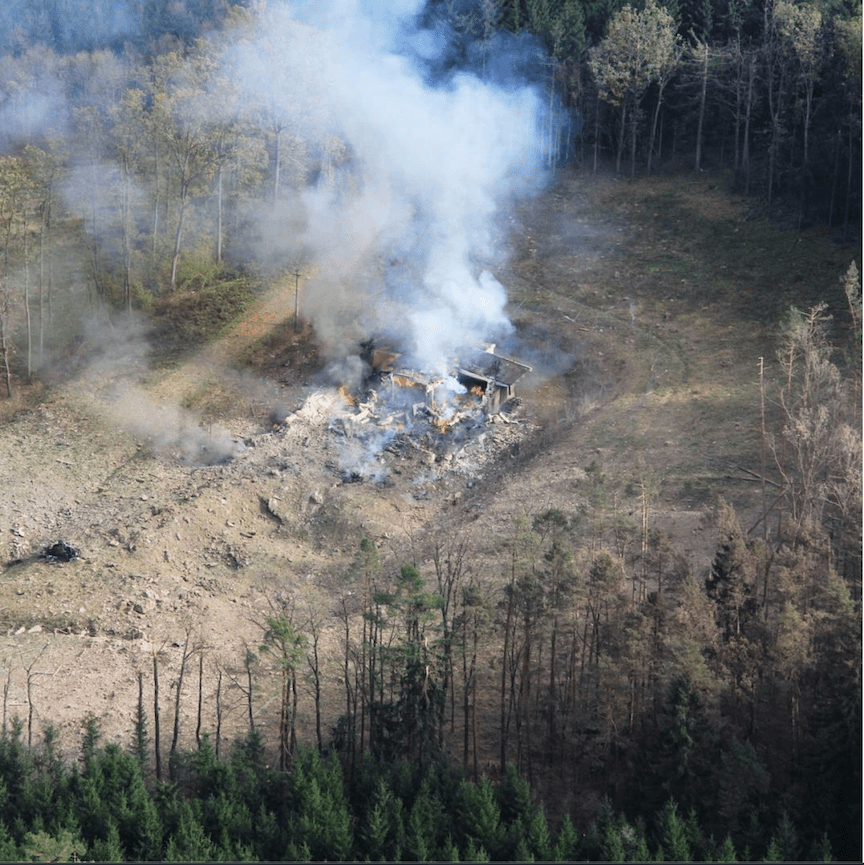
On August 13, a fire and explosion hit the KNDS Ammo Italy ammunition plant at Colleferro, southeast of Rome. No injuries were reported among the 24 employees on site, and the cause remains under investigation. Italian reporting, including ANSA and AGI, placed the initial fire in the powder-pressing department before the main detonation.
Four days earlier, fire and explosions destroyed an ammunition warehouse operated by EMCO near Belitsa in central Bulgaria. Workers were evacuated and no one was injured. Bulgarian Interior Minister Ivan Demerdzhiev said investigators had found no evidence of foreign interference and that the cause appeared more likely internal.
There is no evidence connecting the incidents, and neither currently supports attribution to Russia. But it is the question European security services are now forced to ask, and the fact that it cannot yet be answered is itself the story. Months before either factory burned, the European Commission was already offering companies money to defend these plants.
The Commission’s March 2026 European Defence Industry Programme allows projects expanding ammunition and energetic-materials capacity to add a dedicated physical and cyber protection package. The same call that pays for more powder, explosives and filling capacity can also pay for counter-drone measures and hardened production networks. Security is being tied directly to whether the line can keep producing.

The Bottleneck Is Powder
KNDS Ammo Italy designs and manufactures ammunition components ranging from powder and combustible cartridge cases to explosives, fuzes, metal parts and warheads. The European Commission identified high explosives and propellant powders as the main bottlenecks preventing a faster increase in 155 mm artillery ammunition production.
The EU’s Act in Support of Ammunition Production put about €248 million into powder projects and €124 million into explosives. Shell projects received about €90 million. The Commission selected 31 projects across the program and said industry co-financing would take total investment to around €1.4 billion. It expected the powder and explosives projects to add more than 10,000 tonnes of powder capacity and more than 4,300 tonnes of explosives capacity each year.
The money followed the constraint.
One of those projects is ROLLO. In June 2024, the Commission awarded €41.39 million to a €91.97 million powder-capacity project coordinated by Simmel Difesa, the Colleferro company now operating as KNDS Ammo Italy. The consortium spans KNDS companies in Italy and France, Nammo companies in Norway and Finland, and Latvia’s state-owned State Defence Corporation.
Construction made that network physical on January 8, 2026, when Latvia broke ground on the ROLLO plant in Iecava Parish. The Latvian Defence Ministry says it will be the first plant in the Baltic states producing modular powder charges for 155 mm artillery, with production planned for the third quarter of 2026 at a rate of up to 50,000 charges per year, with a workforce of roughly 20 to 25 people.
ROLLO divides one ammunition function across several states. The Italian coordinator supplies industrial expertise, Latvia adds charge assembly, and French, Norwegian and Finnish companies sit in the same consortium. More capacity also means more production nodes whose availability matters.
Europe concentrated investment on the parts of the round that were hardest to replace.
Russia Has Done This Before
On October 16 and December 3, 2014, explosions destroyed ammunition warehouses at Vrbětice in the Czech Republic and killed two Czech citizens. In April 2024, Czech police concluded their investigation and stated that members of Russian military intelligence carried out both attacks. Investigators identified GRU Unit 29155 and said the motive was to prevent weapons and ammunition from reaching areas where Russian forces were operating.
Bulgaria documented a wider pattern. In 2021, prosecutors linked four explosions between 2011 and 2020 at ammunition or explosives facilities. One hit an EMCO warehouse at Lovnidol in November 2011. Two struck the VMZ Sopot depot at Iganovo in 2015. A fourth hit an Arsenal warehouse near Maglizh in 2020.
Bulgarian prosecutors said the charges in all four cases were activated remotely and that the destroyed production was destined for Georgia and Ukraine. Six Russian citizens were present in Bulgaria around the relevant dates. Prosecution spokeswoman Siyka Mileva said the collected evidence was very reliable and led to the conclusion that the purpose was to stop those munitions deliveries.
A state trying to reduce artillery output does not have to hit a gun or an ammunition train near the front. It can interrupt powder, explosives, storage or filling capacity farther upstream.

The Perimeter Enters the Budget
The Commission’s first 2026 industrial-reinforcement call under EDIP assigns €166.4 million to energetic components. Eligible capacity includes propellant powder, explosives, propulsion systems, warheads, electronic fuzes, filling plants and access to relevant raw materials.
Applicants can add an optional work package specifically to reinforce the physical and cyber protection of the production capacity receiving the industrial investment. The Commission names threat assessment, counter-drone site protection, cyber monitoring, network hardening, secure access and connections to national or European security systems. The protection package can receive up to €500,000 in EU funding per project.
The provision is optional rather than a blanket security mandate. What it changes is category: site protection becomes an eligible part of the same industrial grant used to expand a critical production line.
The energetic-components call closed on June 16, drawing 83 proposals, almost two months before the Colleferro explosion. The security provision was not written in response to the two August incidents. It was already embedded in the program before either factory burned.
The work program states the objective directly. The protection is meant to reduce disruption, sabotage or interference affecting production continuity, ramp-up and deliveries. Applicants must connect security measures to industrial performance, including lead time, throughput, capacity and workforce readiness.
The EU has put the perimeter into the production budget.

Capacity Is Uptime
Ammunition capacity is usually expressed as a yearly number: shells, tonnes of powder, tonnes of explosives. That number assumes the plant is available when the order arrives.
The Commission’s new rules expose the missing variable. A production line that exists but cannot operate is capacity on paper. A powder plant closed by fire, a compromised production network or a filling line shut while authorities clear a security incident all reduce output through lost time.
For propellant and explosives, that lost time travels downstream. Shell bodies can be stamped somewhere else and guns can remain in service, but finished rounds still depend on energetic components arriving in the required quantity and sequence. The Commission identified those materials as bottlenecks before it began offering money to harden the sites that make them. The security provision follows the industrial map.
Colleferro demonstrates the same vulnerability even if the August 13 explosion proves entirely accidental. Energetic-materials plants are hazardous before an adversary enters the equation. An explosion at the same Colleferro site in October 2007, under Simmel Difesa ownership, killed one worker and wounded 13. Industrial accidents and deliberate interference are different causes that can produce the same industrial result: a critical line goes offline.
Bulgarian authorities currently say there is no evidence of foreign interference at Belitsa. The warehouse still burned down.
Europe spent the first phase of the ammunition crisis expanding nominal capacity. Its 2026 funding architecture has begun to price in availability.
Once a privately operated powder plant becomes part of Europe’s wartime ammunition system, who is responsible for defending it like one?